How to Apply for Asylum in the UK: Complete Step‑by‑Step Guide (2026)
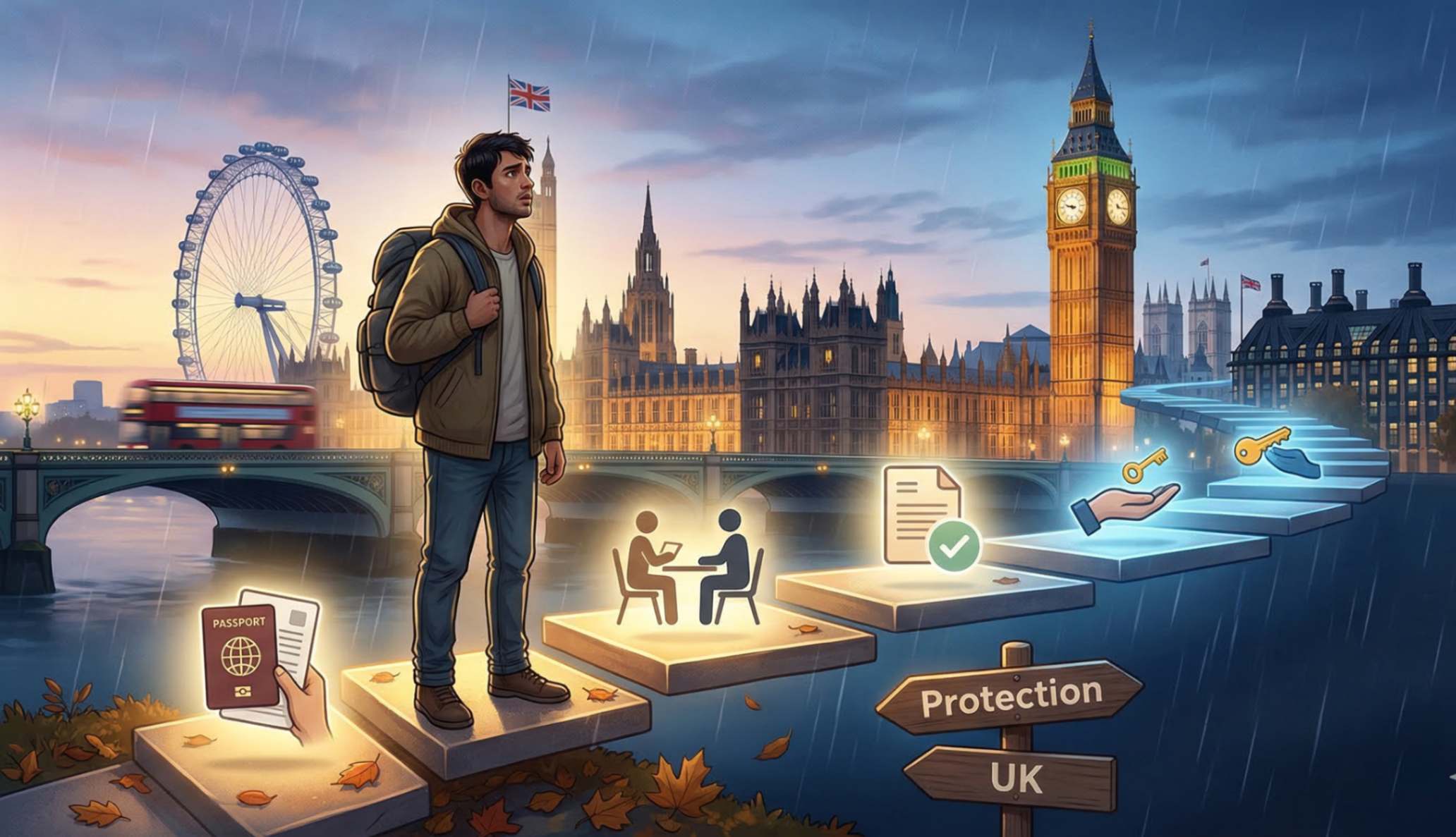
Very important legal warning: This guide is a procedural tool designed to help you understand the administrative steps of applying for asylum in the United Kingdom. It is written based on many years of daily practical experience in the refugee support sector. This article is not, and can never be, a substitute for consulting a qualified immigration solicitor. UK immigration law (especially after the 2024 Act) is extremely complex and constantly changing. Any mistake in the procedure can lead to your claim being refused or to your detention. For a broader overview of the legal framework and types of protection you can obtain, see our guides Asylum in Germany and Asylum in France to compare different systems in Europe.
How to Apply for Asylum in the UK: Complete Step‑by‑Step Guide (2026)
1. Introduction: You are in the UK… what now?
Imagine the scene: you have just arrived in the UK. Maybe after a terrifying journey on a small boat across the Channel, or after days hidden in the dark box of a lorry, or maybe you arrived with a tourist visa by plane and realised that going back to your country means death. Your bag is in your hand, exhaustion is all over you, and fear of removal or Rwanda fills your heart. Where do you go? What do you say to the police? Where do you start?
Welcome, my brother/sister. Sit down and catch your breath. I have seen hundreds of new arrivals in exactly your situation. The UK system (Home Office) is cold, bureaucratic, and fully dependent on strict paperwork and procedures. One mistake at the beginning can cost you your whole case.
In this practical guide I will walk you step by step. I will tell you what will happen in the first hours, how to answer the police questions, how to find a free solicitor, and how to prepare for the most important interview in your life. This is the only “procedural guide” you need to start your journey correctly in the UK. For more on the legal background, also see Asylum in Germany: Conditions and Full Steps and How to Apply for Asylum in France Step by Step.
2. Step zero: Before you start (what should you carry with you?)
Before you open your mouth and claim asylum, you must organise your documents. The Home Office loves physical evidence.
2.1 Essential documents you must protect with your life
- Your passport: even if it is expired or damaged.
- Any other ID document: national ID card, driving licence, birth certificate, or family book.
- Photos of yourself: take 6 to 10 photos with a white background from any photo booth.
- Evidence for your case: medical reports (proving torture), arrest warrants, written threats, newspaper articles mentioning your name, or photos of your destroyed house.
- Evidence of your journey: old flight tickets, train receipts in Europe. (The Home Office will ask you in detail about every step of your journey.)
2.2 What if I lost my passport or papers at sea?
Do not worry, you can claim asylum without a passport.
- The key here: explain the reason honestly. Say: “I lost it at sea”, or “the smuggler took it from me”, or “I destroyed it because I was afraid of being returned in a previous country.” Never say “I do not have a passport” while you are hiding it in your bag; luggage searches are very thorough, and if they catch you lying, you may face a criminal charge (Section 8) and destroy your credibility.
2.3 I have no documents at all and I am on the street right now!
- Do not go to the police directly if you can avoid it. Call a support organisation immediately such as Migrant Help on the free number 0808 8010 503 so they can direct you to the nearest safe place to lodge your asylum claim.
3. First step: Arrival and registering the claim (Screening)
In the UK, you cannot simply send an asylum application by post. Registration must be done in person.
3.1 Where and how do you claim asylum?
- If you arrived irregularly (boat/lorry): you will usually be apprehended by Border Force at the port or on the beach. You will be taken immediately to a short‑term holding facility for quick screening (such as Manston facility).
- If you arrived regularly (airport/visa): stand at the passport control desk at the airport and say one clear sentence: “I want to claim asylum.”
- If you are already inside the UK: you cannot just go to an ordinary police station. You must contact the Asylum Intake Unit to book an appointment in London:
- Number: 0300 123 4193.
- Mandatory place of registration: Lunar House in Croydon (South London).
3.2 The initial screening interview
Whether you are in a holding facility or at Lunar House, you will go through this important procedural interview.
- Duration: one to two hours.
- Purpose: to take your details, fingerprints, and to determine “how you got here”. The purpose here is not to tell your full life story.
Real questions you will be asked (and what they mean):
- “What is your full name, nationality, and date of birth?” (Basic information – make sure you pronounce them clearly so they match your documents.)
- “Please list all the countries you travelled through to reach the UK.” (Mention every country you passed through.)
- ⚠️ Dublin/Rwanda warning: this is the most dangerous question. If you say you passed through France and stayed there for a month, they will ask: “Why did you not claim asylum there?” Answer clearly (for example: you did not feel safe, you were being beaten by smugglers, you wanted to reach the UK because you have relatives here).
- “Do you have any medical conditions or take medication?” Mention everything here! Psychological trauma, signs of torture, or chronic illnesses can legally prevent them from detaining you or removing you quickly.
3.3 What will you receive after this interview?
- Fingerprints (Biometrics): they will photograph you and take your fingerprints for security checks.
- ARC (Application Registration Card): a plastic card with your photo. This is your ID now. If the police stop you in the street, this card protects you from removal.
- BAIL 201 document: a paper setting out the conditions of your stay (your accommodation address and your reporting appointments at the police).
4. Second step: What to do in your first week? (Emergency phase)
You have left the screening interview and you are now in temporary accommodation (often a hotel). What should you do?
4.1 Get a solicitor immediately!
This is the most important decision you will make in your life in the UK. The Home Office has an army of lawyers to refuse you; you must have someone to defend you.
- Free legal aid: as an asylum seeker with no income, you are entitled to a solicitor paid by the state (Legal Aid solicitor).
- How do you find one? Do not just search Google randomly. Use the official government website:
find-legal-advice.justice.gov.uk, or ask hotel staff or Migrant Help to direct you to an accredited law firm. - ⚠️ Warning: do not pay money to “unregistered advisers” in cafés. Only a properly registered solicitor (OISC registered) is legally allowed to represent you.
4.2 Apply for asylum support and housing (Asylum Support – Section 95)
If you have no money and no accommodation, call Migrant Help so they can complete the support application form (ASF1) for you.
- Accommodation: the government will provide you with housing. You cannot choose the city! They may send you to the North of England, Wales, or Scotland.
- Financial support: you will receive a red card (ASPEN card) that is topped up weekly with about £49.18 per person. This amount is only for food and hygiene.
4.3 Register with a GP
Go to the nearest GP surgery in your area. Tell them: “I am an asylum seeker and I need to register.” Treatment is completely free under the NHS. If you need psychological support because of war trauma, ask to be referred to a psychologist – their report will strongly support your asylum case.
5. Third step: Preparing for the substantive interview
This is the “big interview”. You will be called after months (or even years due to the current backlog). Your fate depends on these few hours.
5.1 How to prepare with your solicitor (Statement of Evidence)
- Your solicitor will ask you to write your story in detail. They will then rewrite it in legal form in a document called a witness statement and submit it to the Home Office before the interview.
- The story must be chronological and must answer one question: “Why can I not return to my country?”
5.2 The day of the interview: what to expect?
- Location: usually at Home Office buildings, or by video link from your accommodation.
- Who will be there? You, the interviewing officer, and an interpreter in your language.
- Role of your solicitor: in some complex cases your solicitor may attend, but usually they do not; instead they review the recording or transcript of the interview later.
5.3 Trap questions from inside the Home Office rooms
The officer is not evil, but their job is to look for contradictions and lies (discrepancies).
- “You say the militia came looking for you on 5 March, but in your first screening interview you said you fled in February. How do you explain this?” (Solution: do not panic. If you made a mistake earlier because of stress, say clearly: I was exhausted and scared on the day I arrived and I got the month wrong.)
- “Why did you not move to live in another safe city in your own country (internal relocation) instead of coming to the UK?” (Solution: you must explain why the whole country is dangerous for you – for example: “The militia that is looking for me controls checkpoints everywhere in the country.”)
- “If you are a persecuted Christian, name three main Christian holidays and what is read in them?” (This is asked of those claiming religious asylum to test the genuineness of their faith.)
5.4 Golden tips for the big interview
- Use the interpreter wisely: speak in short sentences and pause for interpretation. If you feel they are shortening what you say or using a dialect you do not understand, stop the interview immediately! Say: “I cannot understand the interpreter.” This is your legal right.
- Absolute honesty: do not exaggerate. If you were not physically tortured, do not claim you were. One lie can destroy an otherwise truthful story.
- Do not be ashamed to mention humiliating details: rape, torture, sexual orientation – you must mention them here. The officer is trained to deal with them confidentially.
6. Fourth step: Life while waiting (the bottleneck)
Waiting in the UK is the hardest stage. You may wait two or three years without a decision.
- Can I work? No. It is completely forbidden. Working “off the books” (cash in hand) is a crime that can lead to your removal. The only exception: if you have been waiting more than 12 months due to Home Office delay, you can ask for permission to work, but you will only be allowed to work in jobs on the “shortage occupation list” (highly skilled jobs such as medicine or software engineering).
- Reporting: you will be required to go weekly or monthly to the immigration reporting centre or police to sign. Do not ever miss an appointment. Missing it means you are considered an absconder and your financial support can be stopped.
- Study: you are allowed to study English (ESOL) for free at local colleges. Use this time to learn and do volunteering – volunteering is allowed and legal.
7. Fifth step: Receiving the decision
After the waiting period you will receive a thick envelope from the Home Office. Open it with your solicitor immediately.
1. Grant of refugee status
- Congratulations! Your claim has been accepted. You will receive a biometric residence permit (BRP) valid for 5 years.
- Immediate steps: you only have 28 days (the move‑on period) before you must leave asylum accommodation and your ASPEN allowance stops. You must immediately apply for Universal Credit, start looking for private or council housing, and look for work. To help you later in your job search, have a look at Best job search sites in France and Best job search sites in Germany as models you can compare with when job opportunities open up for you in the UK.
- Rights: you are allowed to work, travel (with a refugee travel document), and sponsor your immediate family (spouse and minor children). For more on family reunion and its legal framework, see what we wrote about Asylum in Germany and Asylum in France for comparison.
2. Refusal (refusal letter)
- You will receive a long letter explaining in painful detail why you were refused (Reasons for Refusal Letter – RFRL).
- They will usually write: “We do not find your account credible” or “You can safely relocate to your country’s capital city.”
- Do not panic. More than 50% of Home Office refusals are overturned and succeed later at tribunal.
8. Sixth step: Appealing before the tribunal
Your claim was refused? This is your last major battle. You must stand before an independent judge at the First‑tier Tribunal (Immigration and Asylum Chamber).
8.1 The deadly time‑limit (14 days)
You have 14 days only (or 7 days if you are detained) from the date you receive the refusal to lodge your appeal notice with the tribunal.
⚠️ Strict warning: if you are late by even one day, you lose your right of appeal and removal directions will be issued. Call your solicitor the minute you open the refusal letter.
8.2 Will my solicitor stay with me?
In the UK, your Legal Aid solicitor will carry out a “merits test”. If they believe your chances of success at tribunal are above 50%, they will continue representing you for free. If they think your case is very weak, they may refuse to represent you. In that situation you will need to look for a private solicitor at your own cost, or represent yourself before the judge.
8.3 The hearing day
- You will sit in front of a British judge.
- There will be a Presenting Officer acting for the Home Office whose only job is to prove that you are not credible and do not deserve asylum.
- Your solicitor will defend you.
- Your role: you will be cross‑examined with tough questions. Stay calm, be patient, and look the judge in the eye when you answer truthfully.
8.4 Outcome
If the judge allows your appeal, you have won – the Home Office is obliged to grant you asylum. If the appeal is dismissed, removal procedures begin.
9. What if you are finally refused and have exhausted all options?
If you lose in all courts (Appeal Rights Exhausted – ARE):
- Fresh claim: you cannot make a new asylum claim unless there is new and significant evidence that has not been considered before by the tribunal (for example: a death sentence issued against you in your country last week).
- Removal directions: your financial support will be cut off and you will be at risk of being detained at any reporting event in order to be removed by force.
- Voluntary return: this is the option with most dignity. Contact the Home Office to arrange a free return ticket to your country with a small reintegration grant (Voluntary Return).
10. Quick checklist – do not fail because you forgot something
Keep this checklist in your wallet:
- Have I registered with Migrant Help to obtain housing and financial support immediately?
- Have I found an accredited Legal Aid solicitor to start my case?
- Have I informed the Home Office immediately whenever I was moved from one hotel to another? (You must always update your address.)
- Am I attending all my reporting appointments with immigration or police without any absence?
- Have I given all my evidence (medical reports/photos) to my solicitor long enough before the substantive interview so it can be translated?
11. Deadly mistakes that lead to a refusal (avoid them)
- Social media can expose you: the Home Office monitors Facebook, Instagram, and TikTok. If you say you fled religious persecution but your accounts are full of public posts from your country openly supporting that religion, they may refuse you. Clean your accounts and make them private.
- Destroying your passport on arrival: this is the worst advice smugglers give. Deliberately destroying documents (Section 8) makes you legally suspicious and severely damages your credibility.
- Relying on “hotel advice”: “My friend told me to say this and it worked for him.” Every story is unique. The judge will spot a copied story immediately. Your only real reference is your solicitor.
12. Conclusion: A hard road, but justice can prevail
Applying for asylum in the UK in 2026 is a psychological and legal war of attrition. The system is designed to be strict and complex in order to reduce numbers (the “hostile environment”), and the threat of removal or new migration laws is real and frightening.
But the UK is still a country of independent courts. Judges are not under the control of the Home Office; they decide based on evidence. If your story is truthful, you are organised, and you follow legal advice patiently, your chance of starting a new and safe life is still very real.
Call to action: Are you in a hotel waiting for your substantive interview? Or have you just arrived and not found a solicitor yet? Write your question or problem in the comments and we will guide you to the best way to act.
13. Life‑saving FAQs
-
What if I lose my ARC card?
You must report it immediately using the online form on the GOV.UK website. Do not delay because it is your only ID and you need it to receive your allowance at the Post Office or via your payment card. -
How do I get housing in the UK as an asylum seeker?
You do not rent by yourself. Once you claim asylum and state that you are “destitute” (have no money), Migrant Help will coordinate with the Home Office to send you to government‑provided initial accommodation. -
What is the difference between refugee status and humanitarian protection for family reunion?
Both grant 5‑year leave, but in recent years the Home Office has placed strict limits and sometimes prevents those with humanitarian protection from sponsoring their families, while refugees usually keep a strong and largely free right to bring their spouse and minor children. -
What does the Rwanda scheme mean for me personally?
If you entered the UK irregularly (boat/lorry) and it can be shown that you passed through a safe country such as France, then in law the Home Office can freeze your claim and attempt to remove you to Rwanda. This is the major legal battle that solicitors are currently fighting on a case‑by‑case basis.
14. Official sources and links (these are your only references)
- Official government page on claiming asylum (Home Office):
www.gov.uk/claim-asylum - To find a free immigration solicitor (Legal Aid):
find-legal-advice.justice.gov.uk - Migrant Help (24/7 support for housing and complaints): freephone (08088010503) |
www.migranthelpuk.org - Refugee Council:
www.refugeecouncil.org.uk - Bail for Immigration Detainees (if you are detained):
www.biduk.org
Related on this site: Asylum in Germany: Conditions and Steps · Applying for Asylum in Germany Step by Step · Asylum in France: Conditions and Steps · How to Apply for Asylum in France

حسين عبد الله
حسين عبد الله كاتب محتوى ومطور مواقع وتطبيقات، لديه خبرة في إعداد وتحرير المحتوى الرقمي منذ عام 2016، مع اهتمام خاص بالسفر والهجرة والدراسة والعمل والحياة في أوروبا. يعتمد في كتابة مقالاته على البحث في المصادر الرسمية والمعلومات الموثوقة، ويعمل على تحويل المعلومات المعقدة إلى أدلة واضحة وعملية تساعد القراء والمغتربين والطلاب على فهم الإجراءات والفرص في الدول الأوروبية. يجمع حسين بين الخبرة التقنية والعمل التحريري، ويهتم بتقديم محتوى دقيق ومحدث وسهل التطبيق.