Asylum in France: The Ultimate 2026 Guide to Conditions, Process, and Rights
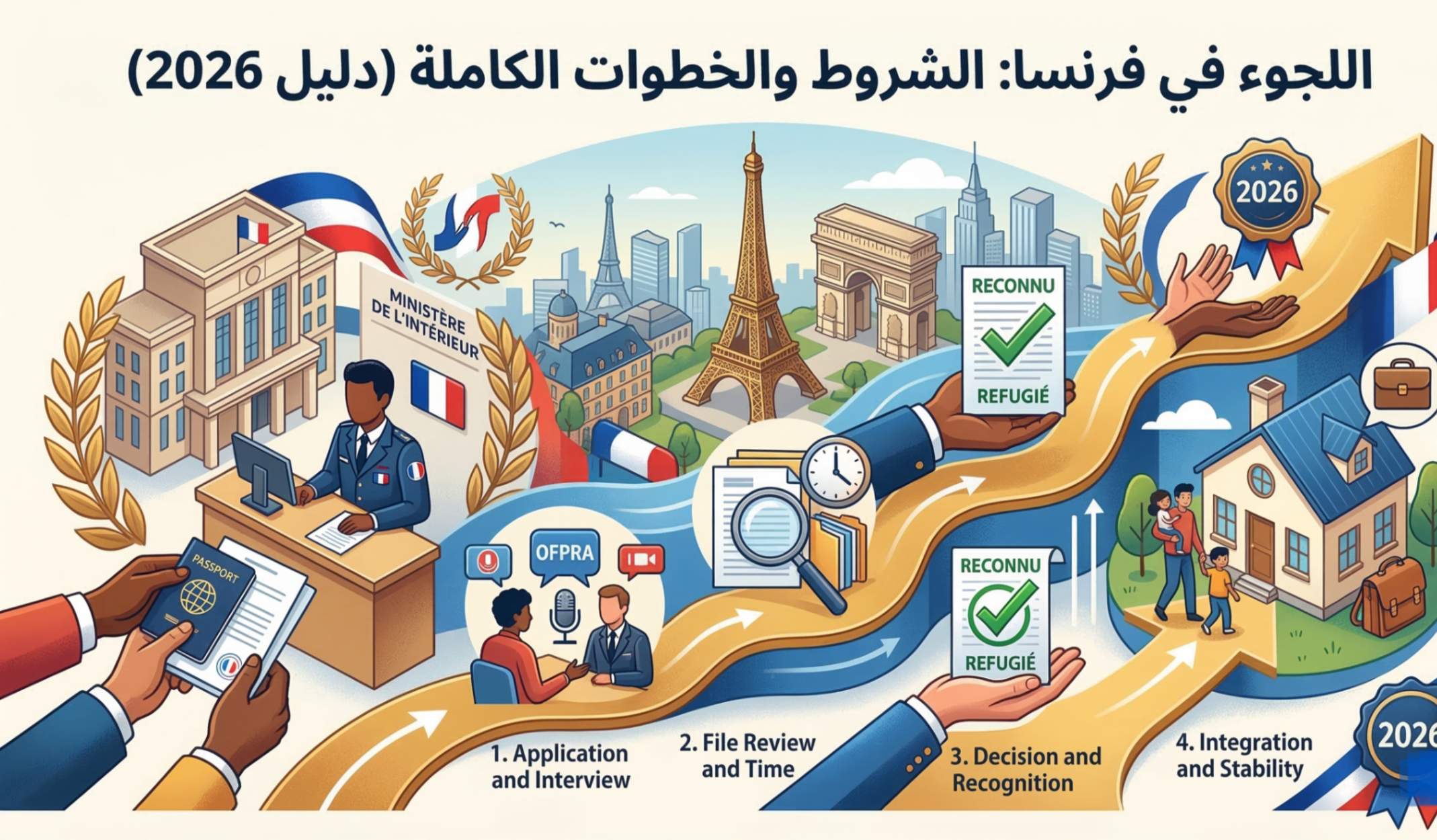
Important Legal Notice: This guide has been comprehensively updated for 2026 and reflects over twelve years of hands-on experience within French asylum organizations (France Terre d'Asile, La Cimade), as well as the current provisions of the Code on Entry and Residence of Foreigners and the Right of Asylum (CESEDA). It does not constitute individual legal counsel. French asylum law is a dynamic field, subject to frequent legislative reforms and rulings by the Conseil d'État. For complex situations—particularly those involving Dublin transfers or administrative detention—consultation with a specialized immigration lawyer is mandatory.
For a granular, step-by-step walkthrough of the application process itself, please refer to our specific procedural guide: How to Apply for Asylum in France: The Complete Step-by-Step Guide (2026).
Asylum in France: Conditions and Complete Steps (2026 Guide)
1. Introduction: France – The Historical Land of Asylum
Picture Samir. He is 42, a pharmacist from Damascus. He didn't choose France because of a specific persecution letter, but because of its enduring reputation as the "Land of Human Rights." His grandmother used to tell him stories about how France welcomed refugees after the Second World War. Now he stands at Charles-de-Gaulle Airport, hoping that tradition holds true for him.
France bears the title "Terre d'asile" (Land of Asylum) for good reason. Since the enshrinement of the right to asylum in the Constitution of 1793 and the Preamble of 1946, protecting the persecuted has been a constitutional principle. Every year, tens of thousands of people—including a growing number of Arabic-speaking protection seekers from Syria, Sudan, Afghanistan, and Yemen—apply for asylum in the French Republic.
However, the romantic notion of a welcoming "asylum land" collides with a complex, often overburdened administrative reality. As an advisor who has spent over a decade in OFPRA waiting rooms and CNDA court corridors, I can tell you: the biggest hurdle isn't the lack of a protection claim, but getting lost in the bureaucratic labyrinth. This guide provides the essential orientation you need—from the legal foundations through the procedural timeline to your rights during the waiting period.
If you're considering a comparison with the German system, I recommend reading our parallel article: Asylum in Germany 2026: Protection, Steps & Rights.
2. Who Qualifies for Protection in France? The Legal Pillars
Contrary to popular belief, France does not automatically grant protection to everyone from a crisis zone. The law strictly distinguishes between two main categories defined in the CESEDA (Code de l'entrée et du séjour des étrangers et du droit d'asile).
2.1 Refugee Status under the Geneva Convention (Statut de réfugié)
This is the highest form of protection, derived from the 1951 Geneva Convention Relating to the Status of Refugees. It is granted if you face individual and targeted persecution or have a well-founded fear of persecution based on one of five grounds:
- Race (e.g., ethnic minorities like Kurds or Rohingya).
- Religion (e.g., conversion, apostasy from Islam, membership in a religious minority).
- Nationality (statelessness or oppression of a national group).
- Political Opinion (opposition work, journalism, conscientious objection to military service in an unlawful regime).
- Membership of a Particular Social Group (the most flexible category, covering sexual orientation, women fleeing FGM or forced marriage, or members of a specific clan).
2.2 Subsidiary Protection (Protection subsidiaire)
This category is a feature of EU law and is highly relevant in France for people from active war zones. It applies when the strict criteria of the Geneva Convention are not met—i.e., individualized persecution cannot be proven—but a return remains impossible due to:
- Imposition or execution of the death penalty.
- Torture or inhuman or degrading treatment or punishment.
- Serious and individual threat to a civilian's life or person by reason of indiscriminate violence in situations of international or internal armed conflict.
Practical Example: A young man from Aleppo who cannot prove political activism but comes from a neighborhood under daily bombardment typically receives subsidiary protection. A political activist from the same city receives refugee status.
2.3 Exclusion Clauses (Who is barred from protection?)
Even if persecution exists, protection can be denied (Art. 1F of the Geneva Convention). This applies to persons who:
- Have committed war crimes or crimes against humanity.
- Have committed a serious non-political crime outside France.
- Have been guilty of acts contrary to the purposes and principles of the United Nations.
2.4 The Theory of "Safe Countries of Origin" (Pays d'origine sûrs)
France maintains a list of countries it considers democratic and free from systematic persecution. As of 2026, this list includes: Albania, Armenia, Bosnia-Herzegovina, Georgia, Ghana, India, Kosovo, North Macedonia, Mauritius, Moldova, Mongolia, Senegal, Serbia, and Tunisia (the only Arabic-speaking country on the list).
⚠️ Fatal Consequence: If you are a national of one of these countries, your application will be processed under the "Procédure accélérée" (accelerated procedure). This means your OFPRA interview often takes place within 15 days, you have less preparation time, and the statistical recognition rate is in the single digits—unless you present irrefutable evidence that the state cannot or will not protect you despite general safety (e.g., a Tunisian journalist with a concrete arrest warrant).
3. Arrival in France: The Crucial First Hours and Days
Imagine Hana. She fled Khartoum and lost everything in Libya. She arrives in Marseille by boat. No passport, no money, no clue. What is her first move?
The procedure depends entirely on the point of entry:
| Situation | Procedure | Critical Note |
|---|---|---|
| At Airport/Port without Visa | Zone d'Attente. You must request asylum immediately from the Border Police (PAF). | You will be held in a transit zone. A judge decides within 96 hours if your claim is "manifestly unfounded" or if you can enter to apply. Call an NGO like Anafé immediately. |
| Entry via Land (Schengen Border) | You are already inside France. Do not go to the police. Find an NGO. | The 90-Day Rule: Do not wait months to apply. Delaying more than 90 days without a valid reason (illness, detention) triggers the accelerated procedure. |
| With a Valid Visa (Tourist, Student) | You can apply for asylum while the visa is valid. | Do it immediately. An expired visa makes access to the normal procedure much harder. |
3.1 The Invisible Hurdle: The Postal Address (Domiciliation)
Before anything else, you need an address in France. No address = No application. If you don't have housing (and most new arrivals don't), you must go to an accredited humanitarian organization (e.g., Secours Catholique, Armée du Salut, Croix-Rouge) and request a "Domiciliation." This address is your lifeline for all official correspondence.
4. The Administrative Pathway: From SPADA to GUDA
4.1 SPADA: The Gateway to the System
In France, access to the asylum process is not direct through the immigration office (Préfecture). You must first visit a SPADA (Structure de Premier Accueil des Demandeurs d'Asile). These are intake centers run by NGOs on behalf of the state.
- In the Paris Region: Appointment by phone only via the OFII hotline.
- In the Provinces: In-person appearance. Bring your Domiciliation certificate.
Here, a brief summary of your flight reasons is recorded, and you receive an appointment for the GUDA (Guichet Unique).
4.2 GUDA: The Day the Procedure is Set
The GUDA is the official starting line. The Préfecture and OFII work side-by-side here.
-
Préfecture Counter (Identity & Eurodac):
- Your fingerprints are scanned and checked against the Eurodac database.
- Dublin Reality: If there's a hit (e.g., Italy, Greece, Germany), you'll be asked: "Were you there?" Denial is futile and counts as deception. You'll receive an Attestation de demande d'asile "Procédure Dublin." This means France is checking if it can send you back to the first entry state.
- Crucial Info: If France fails to transfer you within 6 months (or 18 months if you abscond), responsibility shifts back to France, and you can continue your procedure here. Many applicants "survive" the Dublin deadline through patience and proper address registration.
-
OFII Counter (Social & Housing):
- This determines if you get a state shelter (CADA) or must fend for yourself. Be honest about health and vulnerability.
- You apply for the ADA card (financial assistance) here.
5. The Heart of the Process: The OFPRA Decision
After the GUDA, you receive the OFPRA form. The clock starts ticking: 21 days.
| Procedure Type | Deadline for Submission | Characteristics |
|---|---|---|
| Normal (Procédure normale) | 21 days | Several months wait for interview. Time for NGO counseling. |
| Accelerated (Accélérée) | 15 days | Fast interview. Higher refusal risk. Applies to "Safe Countries," Dublin cases, repeat applications. |
5.1 The Récit: Your Written Testimony
The OFPRA form contains blank pages for your story. This is Le Récit.
- Content: No political analysis. No Wikipedia copy. Just your personal chronology. What happened to you? When? Where? Who was involved?
- Language: French. Translation help from NGOs (like La Cimade) is invaluable here.
- Evidence: Anything that supports the story (medical certificates of torture scars, photos, summonses) must be included as copies.
6. Comparing Protection Statuses: Refugee vs. Subsidiary
| Criterion | Refugee Status (Réfugié) | Subsidiary Protection (Protection Subsidiaire) |
|---|---|---|
| Legal Basis | 1951 Geneva Convention | EU Directive / Art. L.512-1 CESEDA |
| Residence Permit | 10 Years (Carte de résident) | 4 Years (renewable) |
| Travel Document | Blue Refugee Passport (Titre de voyage) | Grey Travel Document (more limited) |
| Family Reunification | Full Right (Spouse, children under 18) | Full Right (Equal to Refugee in FR!) |
| Naturalization | No waiting period (immediate application) | 5 years' residence required |
| Cessation of Protection | Upon voluntary return or change of circumstances | Upon end of conflict situation (regular review) |
Expert Note: Family reunification for those with subsidiary protection is significantly more generous in France than in Germany! Therefore, if you are from a war zone, the main practical differences between Refugee and Subsidiary status are the length of the residence permit and the waiting time for citizenship. Your nuclear family can join you in both cases.
7. The OFPRA Interview: The Moment of Truth
Months after submitting the dossier, you receive a Convocation. The interview takes place in Fontenay-sous-Bois near Paris (or in regional offices).
- Attendees: An Officier de Protection (not a judge, but a specially trained official), a sworn interpreter (free of charge), and you.
- Duration: 1 to 3 hours.
- Questioning Style: The officer tests the internal logic of your Récit. They ask trick questions.
- Question: "You say you were at the protest in City X. Describe the main square."
- Goal: Testing local knowledge.
- Your Response: Stay calm. If you don't know, say: "I don't remember, I was terrified." Lying destroys credibility completely.
8. The Appeals Process: From OFPRA to CNDA
8.1 The OFPRA Decision
- Accord: You receive a letter. Take it to the Préfecture to apply for your Carte de résident. Read more: Refugee Rights in Switzerland: A Guide (for an Alpine comparison) or our France-specific guide (coming soon).
- Rejet: Approximately 65% of OFPRA decisions are negative. This is not the end.
8.2 The CNDA (National Court of Asylum)
You can appeal an OFPRA rejection within 30 days.
- Aide Juridictionnelle (Legal Aid): You can request a free lawyer. The court appoints a specialized attorney for you. Important: Applying for Legal Aid stops the 30-day clock.
- Hearing: The CNDA is a real court. Judges wear robes. Your lawyer can legally dismantle the OFPRA decision. The success rate at the CNDA is significantly higher than at OFPRA.
9. Life in Limbo: Material Rights During the Procedure
France provides a subsistence minimum for asylum seekers. Compare this with benefits in other countries, e.g., Salaries in the UK: The Complete Guide 2026 or Salaries in Switzerland 2026 Guide.
9.1 The ADA Card (Financial Assistance)
| Category | Amount per Day (2026) | Monthly Total (approx.) |
|---|---|---|
| Single Adult (without housing) | €14.50 | €435 |
| Couple (without housing) | €10.30 per person | €618 |
| Family with 2 Children | Varies, approx. €30 total/day | approx. €900 |
ADA is loaded onto a red debit card. You can shop at supermarkets but cannot withdraw cash.
9.2 Accommodation (CADA/HUDA)
- CADA: Centers with social workers. Very scarce. Less than 40% of applicants get a spot.
- HUDA: Emergency shelters (hotels, hostels). Often isolated and far from city centers.
9.3 Health Insurance (PUMa/CSS)
You are not eligible for AME (that's for undocumented migrants). You are entitled to the regular statutory health insurance PUMa with CSS supplement. This means:
- Doctor visits: Free (no co-pay).
- Medication: Free at the pharmacy.
- Hospital: 100% coverage.
9.4 Work Authorization
General Rule: Prohibited. Exception: After 6 months of waiting without an OFPRA decision, you can apply for a work permit from the DIRECCTE. Requirement: A concrete job offer in a shortage occupation (e.g., construction, hospitality, IT). Difficult in practice, but possible. For later job searching: Best Job Search Sites in France 2026.
10. Family Reunification (Réunification Familiale): France's Major Advantage
Once you have protection status (Refugee or Subsidiary), you can bring your nuclear family.
- Who is eligible?
- Spouse: The marriage must have taken place before the asylum application.
- Minor Children: Under 18 at the time of the asylum application. Reunification for children over 18 is extremely difficult.
- Parents of an unaccompanied minor refugee.
- Procedure: The French consulate in the family's country of residence issues a "Visa de réunification familiale."
- Special Feature: You do not need to prove income or adequate housing to bring your family. The state waives these requirements for protection beneficiaries.
11. The 5 Most Fatal Mistakes by Arabic-Speaking Applicants
- The "Café Story": Paying €500 for a "perfect story." OFPRA has a database of text modules. These stories lead to 100% rejection.
- Ignoring Mail: "I didn't check my Domiciliation for two weeks." The OFPRA summons arrived during that time. Result: Clôture du dossier (File Closed).
- Voluntary Contact with Home Embassy: Need a passport? Never go to the embassy of your persecuting state. OFPRA views this as proof of trust in that government and can revoke your protection status.
- Traveling to Home Country: Even after recognition: a refugee who vacations in their home country will have their protection withdrawn (Art. L.511-8 CESEDA).
- Illegal Work Before Authorization: If the police catch you working without a permit, you risk an OQTF (Deportation Order).
12. Conclusion: Asylum in France – A Marathon, Not a Sprint
France offers a sophisticated and, by European comparison (especially regarding family reunification), very fair asylum system. But the path is arduous. Waiting times are long, the administrative language is a barrier, and the psychological toll is heavy.
But remember Samir and Hana. They made it because they didn't let the bureaucracy intimidate them. They understood the system and sought help from the right places. Use the waiting time actively. Learn French—the OFII offers up to 400 hours of free classes! Volunteer. The more visible your willingness to integrate, the more positively your environment will react.
We want to hear your story! Where are you currently in the process? What hurdles have you faced? Share your experiences in the comments and help the community.
13. Frequently Asked Questions (FAQ)
Q: How much is ADA exactly for a family with one child? A: A single adult receives €6.80 base + €7.40 housing = €14.20/day. Two adults without housing: €28.40/day. An additional supplement (approx. €4-5) is added per child. Rates adjust annually on April 1st.
Q: I have refugee status. When can I become a French citizen? A: As a recognized refugee, you can apply for naturalization immediately (you are exempt from the 5-year residency requirement for "ordinary" foreigners). However, you must speak French at B1 level and demonstrate integration.
Q: What happens if I am a Dublin case (hit in Italy)? A: You will receive a transfer order (Arrêté de transfert). You have 14 days to appeal to the Administrative Court (Référé). Stay in France, update your address, and if France fails to deport you within 6 months, France becomes responsible for your asylum case.
Q: Can I travel to another EU country during the procedure? A: No. You have a residence permit only for France. Leaving France forfeits your claim here and risks detention in the neighboring country.
Q: My children are 19 and 20. Can I bring them over? A: Unfortunately, no. Family reunification for protection beneficiaries applies only to children who were under 18 on the day the asylum application was lodged. For adult children, you would need to apply for a "regular" visa (visitor/student), which is very difficult.
14. Official Sources and Further Reading (April 2026)
- OFPRA (French Office for the Protection of Refugees): www.ofpra.gouv.fr/en/
- CNDA (National Court of Asylum): www.cnda.fr/en/
- Service-Public.fr (Official Administration Portal): Asylum Procedure
- Ministry of the Interior – Asylum: Guide for asylum seekers in France
- La Cimade (NGO Support): www.lacimade.org/en/
- France Terre d'Asile: www.france-terre-asile.org
- GISTI (Legal Information Group): www.gisti.org
- Legifrance (Legal Database): CESEDA Code
- Ameli (Health Insurance): www.ameli.fr/en
Internal Links (Arab in Europe):
- How to Apply for Asylum in France Step by Step (2026)
- Asylum in Germany: Protection, Steps & Rights
- How to Apply for Asylum in Germany Step by Step
- Best Job Search Sites in France 2026
- Scholarships in France: The Complete Guide 2026
- Studying in France 2026: Complete Guide
- Refugee Rights in Switzerland: A Guide
- German Citizenship: The Complete Guide 2026
- Asylum Refusal Reasons in the UK: 20 Common Causes
- Asylum in Norway: Conditions and Steps
حسين عبد الله
حسين عبد الله كاتب محتوى ومطور مواقع وتطبيقات، لديه خبرة في إعداد وتحرير المحتوى الرقمي منذ عام 2016، مع اهتمام خاص بالسفر والهجرة والدراسة والعمل والحياة في أوروبا. يعتمد في كتابة مقالاته على البحث في المصادر الرسمية والمعلومات الموثوقة، ويعمل على تحويل المعلومات المعقدة إلى أدلة واضحة وعملية تساعد القراء والمغتربين والطلاب على فهم الإجراءات والفرص في الدول الأوروبية. يجمع حسين بين الخبرة التقنية والعمل التحريري، ويهتم بتقديم محتوى دقيق ومحدث وسهل التطبيق.