British Citizenship: The Complete Guide (Requirements, Steps, Costs & Life in the UK Test 2026)
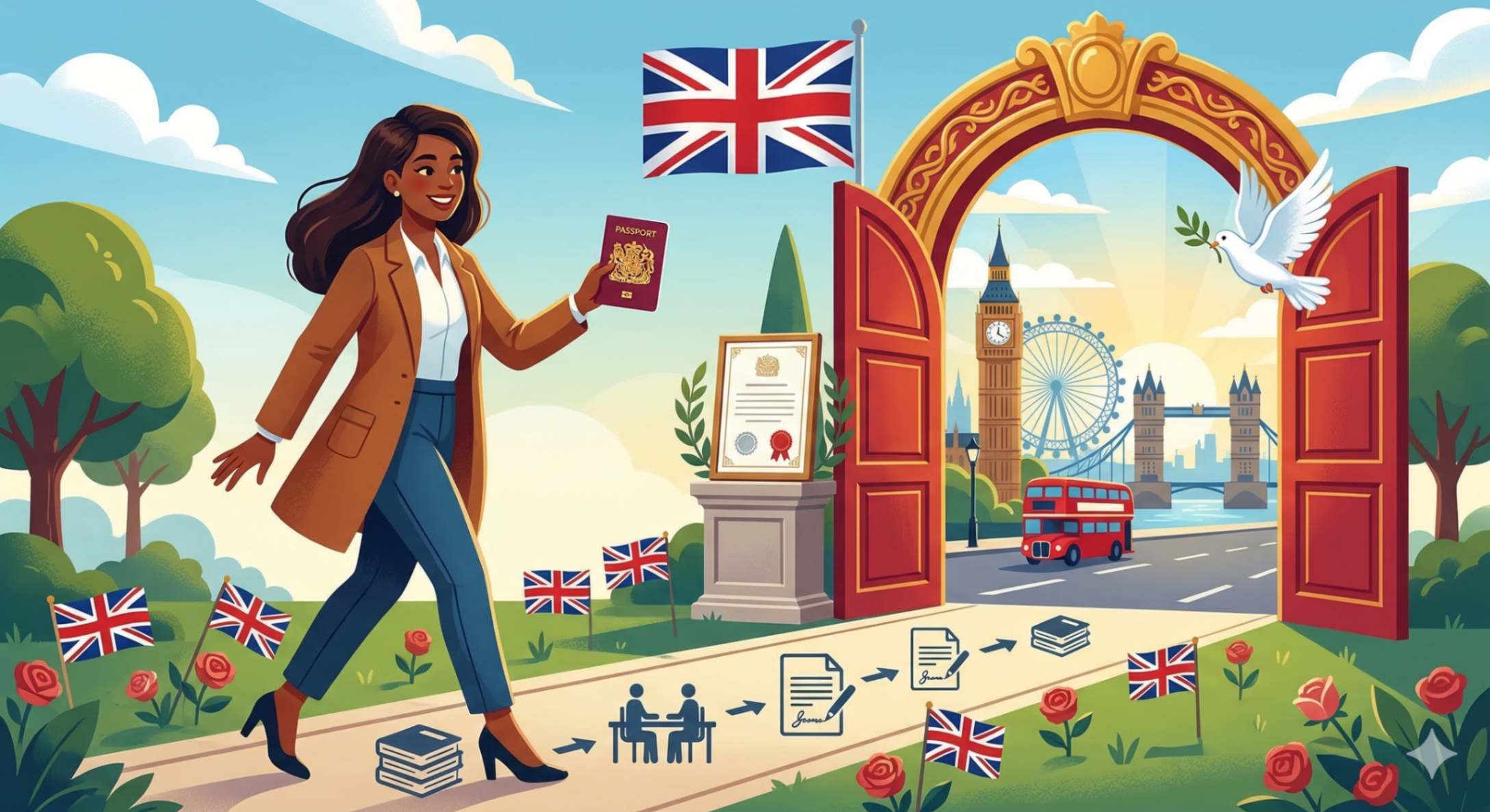
Welcome to the final station of a long immigration journey. I met a solicitor specialised in British nationality law, working in the heart of London for more than 15 years. He told me: I can say with confidence that the moment my client receives their Certificate of Naturalisation is always an emotional moment you will never forget.
British citizenship isn’t just a dark-blue document (as the passport colour changed after Brexit) that helps you pass through airports. It’s a full declaration of belonging, absolute constitutional protection that prevents deportation no matter what happens, and a right to shape the future of this country through elections.
However, reaching this stage requires surgical accuracy when dealing with the UK Home Office. The rules change, fees increase every year, and a single mistake in calculating the days you spent outside the UK can lead to a rejection and the loss of thousands of pounds.
In this legal and procedural guide for 2026, I will put in your hands a complete, detailed roadmap to ensure your application succeeds from the first attempt.
British Citizenship: The Complete Guide (Requirements, Steps, Costs & Life in the UK Test 2026)
1. Introduction: British citizenship... the ultimate goal
After years of paying taxes, proving integration, and overcoming obstacles related to temporary residence, obtaining British citizenship becomes the natural culmination of your journey.
What British citizenship means for you in practice:
- Right to vote: you can vote and run for office in all elections (local and general).
- A global passport: a British passport allows visa-free travel (or visa-on-arrival) to more than 180 countries.
- Absolute security: unlike ILR, which can be withdrawn if you commit a serious crime or leave the UK for more than two years, British citizenship gives you full protection against deportation.
- Transmission of citizenship: children born after you obtain citizenship automatically and inevitably become British.
2. Ways to obtain British citizenship
British nationality law from 1981 is complex, but it divides citizenship into main routes:
2.1 Naturalisation
This is the route intended for adults (18+). You have moved to the UK, obtained permanent residence, and you now want to become a British citizen. (This guide focuses entirely on this route).
2.2 Registration
This route is often intended for children (under 18) born in the UK before their parents obtained permanent residence, or for people who have a historical connection to Britain (such as citizens of overseas territories). The registration requirements are usually easier and cheaper than naturalisation.
2.3 Citizenship by birth (Birth)
The golden rule in the UK: being born on British soil does not automatically give citizenship! A child born in the UK is British only if at least one parent is a British citizen, or holds permanent residence (ILR / Settled Status) at the time of the child’s birth.
2.4 Citizenship by descent (By Descent)
If you were born outside the UK and one of your parents is a British citizen (in a non-bloodline manner), citizenship is transferred to you automatically.
3. Core requirements for Adult Naturalisation
To have your application accepted, you must meet all of these five conditions without any exception:
3.1 Continuous lawful residence requirement (Residency Requirement)
-
General rule: you must have lived in the UK for 5 years in a legal and continuous manner.
-
The 12‑month requirement: you must have 12 full months since the date you obtained ILR (or EU Settled Status) before the day you submit your citizenship application. (Example: if you obtained ILR on 1 January 2025, you can apply for citizenship on 2 January 2026).
-
Strict absence rules (Absence Rules):
-
Your total number of days absent from the UK must not exceed 450 days across the five years.
-
Your absence must not exceed 90 days in the last year (the 12 months that immediately precede your application).
-
Exceptions: if you exceed slightly due to compelling circumstances (serious illness, a pandemic, or mandatory work for a UK company abroad), the Home Office may be more flexible, but you must include a strong legal explanation.
-
3.2 English language requirement
You must prove your ability to communicate in English at least at B1 (CEFR) level.
- How can you prove it?
- Pass an approved language test (such as IELTS Life Skills B1 or Trinity GESE Grade 5) at an SELT-approved centre.
- Or submit a university degree (bachelor or master) taught in English (if your degree is from outside the UK, include an equivalence letter from ECCTIS proving it meets the UK standard and was taught in English).
- Or if you hold the nationality of an English-speaking country (such as the USA, Canada, Australia).
3.3 Life in the UK Test
-
What is it? A mandatory computer test that measures your knowledge of British history, culture and laws.
-
Details:
- 24 questions (multiple choice).
- Duration: 45 minutes.
- Passing score: 75% (meaning you need 18 correct answers).
- Cost: 50 pounds sterling.
-
How to study: you should buy or read the official Home Office approved book “Life in the United Kingdom: A Guide for New Residents (3rd Edition)”. I strongly recommend downloading free training apps to practice with previous questions every day.
-
Exemptions: the test and the English language requirement are waived for anyone under 18, or over 65, or who has a severe and long-term mental or physical disability preventing learning (based on an accurate medical report).
3.4 Good character requirement
This is the trap many people fall into. The Home Office performs a comprehensive security check (Background check) on your file.
- What destroys “good character”?
- Criminal record: imprisonment sentences longer than 4 years permanently prevent you from citizenship. Lower sentences require a long waiting period (up to 10 years) after the punishment ends before you can apply.
- Immigration breaches: if you worked without permission, or stayed in the UK after your visa ended (Overstaying) during the last 10 years, your application is likely to be refused.
- Tax evasion or bankruptcy: if you owe HMRC money and have not paid it.
- Traffic offences: a single speeding fine usually isn’t enough to block you, but repeated offences (or driving under the influence of alcohol) can lead to refusal.
3.5 Intent to reside
You must declare your intention to make the UK your main home. If your work, family and entire life are outside the UK, the Home Office may doubt your intention and reject your application.
4. Citizenship timeline (when should you apply?)
| Your immigration route | Required residence length | When are you allowed to apply? |
|---|---|---|
| General route (work / skills visa) | 5 years for ILR | After 12 months from the date ILR is issued |
| Refugee (Refugee / Humanitarian) | 5 years (counted from the asylum date) | After 12 months from receipt of ILR |
| Married to a British citizen | 5 years to obtain ILR (usually) | Immediately once you receive ILR (no 12-month waiting period required, but your total residence in the UK must be at least 3 years). |
| EU nationals (Settled Status) | 5 years | After 12 months from the date your Settled Status is granted |
5. Documents required for submission (checklist)
Because the UK uses a digital application system, you will need to scan (Scan) the following documents:
- Your current passport (and previous passports covering the 5-year period to prove your travel).
- Your biometric permanent residence card (BRP - ILR).
- Your pass certificate for the (Life in the UK Test) including its reference number.
- Your approved English language certificate (SELT) or your university degree equivalence (ECCTIS).
- Two referees (Referees): two people who have known you for 3 years must sign your photo and forms. (One must be a British citizen, and the other must be a respected professional such as a doctor, lawyer, or company director).
- For spouses of British citizens: marriage certificate, and the British spouse’s passport to prove their citizenship.
(Important note for refugees: If you don’t have a passport from your country of origin, the refugee travel document (Travel Document) and your residence card are enough as identity proof).
6. Step-by-step application process (how to apply?)
6.1 Online application
- Go to
Gov.ukand search for (Apply for British citizenship by naturalisation). - Create an account, and answer every question accurately (including the dates of every journey you made outside the UK during the last five years).
- At the end of the application, you will pay all fees online by bank card and click (Submit). This is the official “application date”.
6.2 Upload documents and book your biometrics appointment (UKVCAS)
After payment, you will be redirected to the company site (Sopra Steria - UKVCAS) responsible for taking your fingerprints:
- Upload (Upload) all your documents in PDF format.
- Book an appointment at the nearest (UKVCAS) centre.
- Go to your appointment to have your fingerprints and biometrics photo taken.
6.3 Processing time
In general, it takes the Home Office 3 to 6 months to process the application and issue a decision. In some complex cases (that require longer security checks), processing may extend up to a year.
6.4 Citizenship ceremony (the decisive moment)
If your application is approved, you will receive an invitation letter (Invitation Letter) to attend a mandatory citizenship ceremony at your local council (Local Council) for your city. You have only 3 months to book the ceremony.
- What happens at the ceremony? You will stand and repeat the Oath of Allegiance to the King of the United Kingdom (King Charles), pledging to respect the rights and freedoms of the United Kingdom. After the oath, you will be handed your Certificate of Naturalisation directly. From that second, you are a British citizen!
6.5 Apply for your British passport
The certificate of naturalisation is not a travel document. After the ceremony, you will return to Gov.uk to apply for your first British passport, and you will send them the original naturalisation certificate (which will be returned to you later). Your passport issuance usually takes around 3 to 6 weeks.
7. Costs and fees for British citizenship (updated for 2025/2026)
British citizenship is one of the most expensive in the world. This is the budget you should prepare:
| Administrative item | Approximate fee in pounds (£) |
|---|---|
| Naturalisation application fee (adult) | 1,630 pounds (includes 80£ ceremony fee) |
| Registration fee (child under 18) | 1,214 pounds |
| Life in the UK Test fee | 50 pounds |
| English language test fee (SELT B1) | 150 pounds |
g>Biometrics appointment (UKVCAS) |
from 0 (free appointments are rare) to 140 pounds |
| Fee for the first British passport | 88.50 pounds (online submission) |
| Total estimate (adult) | around 1,950 to 2,050 pounds |
⚠️ Serious legal warning: citizenship fees are non‑refundable (Non-refundable). If your application is refused because you miscalculated your days of absence, or because you did not disclose an old traffic offence, the Home Office can take the full amount of £1,630.
If you want to compare the costs with your real income, read also Salaries in the UK: The Complete Guide.
8. Special cases you must pay attention to
8.1 Children born in the UK
If your child is born in the UK after you obtained ILR, they are British by birth and do not need to pay the naturalisation fee (1,214£). Instead, they apply directly for a passport (only 88£). If the child was born before you obtained ILR, you must register them and pay the full fees.
8.2 Citizenship for refugees (Refugees)
If you are a refugee, the 5 years you spent as a refugee are counted within the residency requirements. You must be careful about one point: travelling to your country of origin! If you use your travel document to return to your country of origin (the one where you said you were persecuted) during your period of residence, your citizenship application will be rejected immediately. Worse: your residence could be withdrawn and your refugee status removed.
For details about asylum procedures and how to read your file legally, also consult Asylum in the UK: Conditions and Full Steps and How to apply for asylum in the UK step by step.
9. Common reasons for refusing a citizenship application (avoid them)
From reviewing hundreds of refused files, these are the fatal mistakes:
- Hiding your criminal record: not disclosing a police caution (Caution) or a driving fine because you think it’s “not important”. Lying or hiding (Deception) leads to refusal and a 10-year ban from applying.
- Applying too early: applying before completing the full 12 months from the ILR receipt date. (Even one day early: your application will be refused and you lose the fees).
- Exceeding absence days (450 days): many business owners fall into this trap because they travel too much.
- Not paying taxes: working in the UK for a period without declaring your income to HMRC, or having unexplained tax gaps.
10. Dual citizenship
Good news: the UK fully allows and tolerates dual citizenship. The British government does not ask you to renounce your original nationality (Arabic) to become British. You can carry two passports.
- But watch out: you must verify that your country of origin allows dual citizenship. Countries such as (Syria, Lebanon, Egypt with prior approval, Iraq, Jordan, Morocco, Tunisia, Sudan, Algeria) allow it. While some other countries (such as certain Gulf countries) may revoke your citizenship if you voluntarily naturalise in another nationality.
11. Conclusion: Your British passport… the end of one journey, and the start of another
Obtaining British citizenship permanently closes the file of permanent anxiety related to changing immigration rules. It is the moment you stop standing in the exhausting “All Other Passports” line at Heathrow and instead move confidently through the “UK Citizens” gates.
Don’t rush the application. Review your papers, test your language, pay your taxes. And if even the smallest doubt appears about your days of absence or an old violation, consult a certified solicitor. £2,000 is not “small” enough to risk for that.
Call to action: Are you in the preparation stage for the Life in the UK test? Or do you have a question about how absence days are calculated? Leave your question in the comments and I will answer it based on my legal experience!
To compare nationality rules in another European country, you can also read German citizenship: the complete guide after the 2024 reform.
12. Quick FAQ
- Can I travel with my current passport while waiting for the citizenship decision? Yes. After the biometrics appointment (UKVCAS), your passport and card (BRP) are returned to you and you can travel. Still, you should avoid travelling for very long periods.
- Do I need to retake the Life in the UK test if I fail? Yes. You can retake it as many times as you want! Each attempt costs 50 pounds. You must pass it before applying for citizenship.
- If I’m married to a British citizen, do I need to wait 12 months after ILR? No. This is the major benefit for those married to British citizens. You are allowed to apply for citizenship the day after you receive your ILR card immediately.
- What happens to the BRP card after citizenship? Once you receive your naturalisation certificate at the ceremony, you must send your old BRP card to the Home Office so it can be destroyed (it is cut into 4 parts). Not returning it exposes you to a 1000‑pound fine!
13. Official sources and legal links (your legal references)
- To start your online citizenship application (Form AN): www.gov.uk/apply-citizenship-indefinite-leave-to-remain
- The official site to book the Life in the UK test: www.gov.uk/life-in-the-uk-test
- List of approved English test centres (SELT): www.gov.uk/english-language
- UKVCAS booking site: www.ukvcas.co.uk
- To apply for your British passport after naturalisation: www.gov.uk/apply-renew-passport

حسين عبد الله
حسين عبد الله كاتب محتوى ومطور مواقع وتطبيقات، لديه خبرة في إعداد وتحرير المحتوى الرقمي منذ عام 2016، مع اهتمام خاص بالسفر والهجرة والدراسة والعمل والحياة في أوروبا. يعتمد في كتابة مقالاته على البحث في المصادر الرسمية والمعلومات الموثوقة، ويعمل على تحويل المعلومات المعقدة إلى أدلة واضحة وعملية تساعد القراء والمغتربين والطلاب على فهم الإجراءات والفرص في الدول الأوروبية. يجمع حسين بين الخبرة التقنية والعمل التحريري، ويهتم بتقديم محتوى دقيق ومحدث وسهل التطبيق.