How to apply for asylum in Switzerland: The complete step-by-step guide (2026)
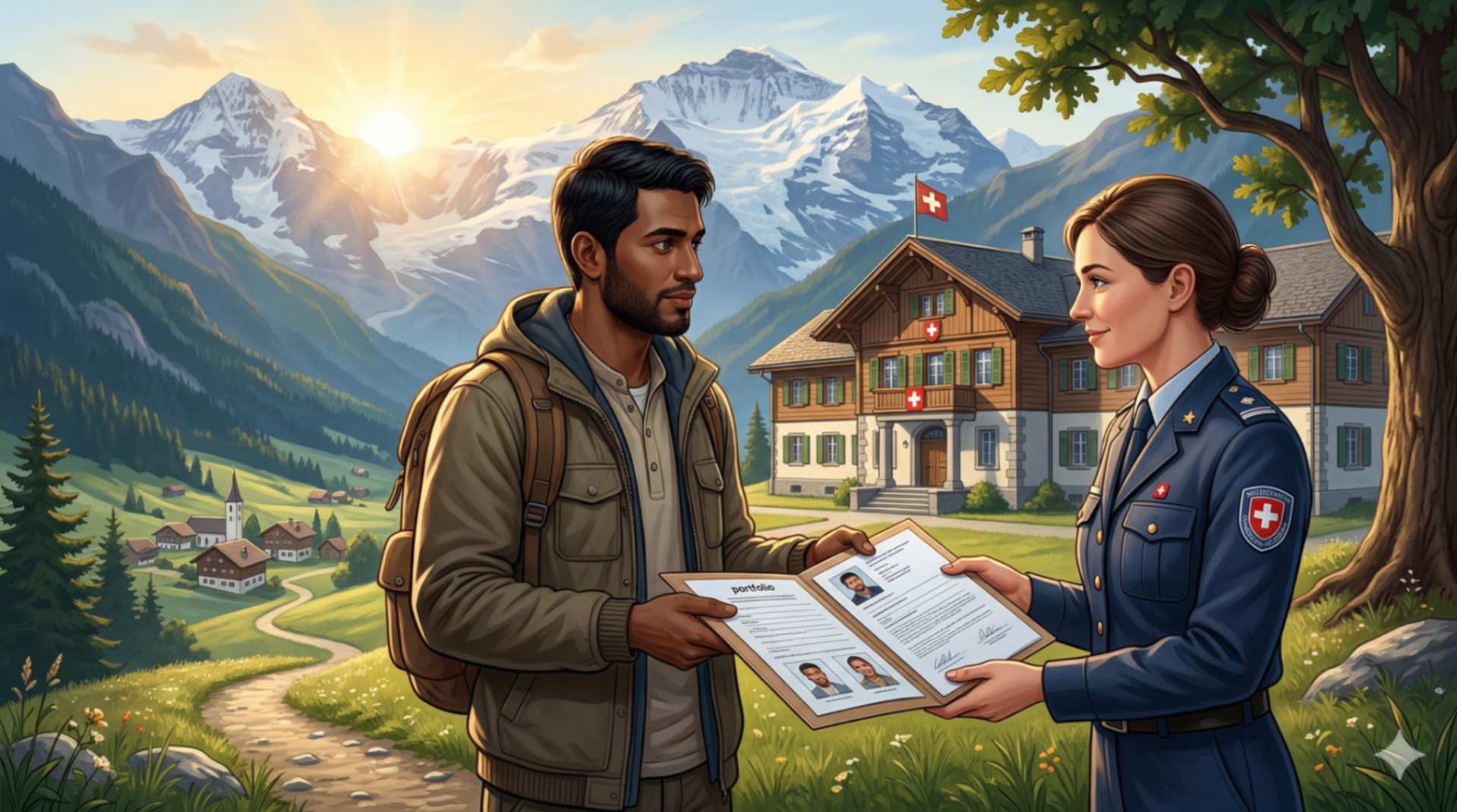
Legal and Liability Notice: This guide is an informational and educational tool, designed to help you understand the complex procedural steps of applying for asylum in Switzerland based on practical practice. Written on the basis of the Swiss Asylum Act (AsylG) 2026. This article is not a substitute for individual legal advice. Switzerland is characterized by a strict federal system, and procedures may differ in precise details between the 26 cantons. If your case is complex, you should consult your free legal representative at the federal center or hire a specialized lawyer.
To build a broader understanding of the labor and living market in Europe after legal settlement, see also Asylum in Switzerland: complete conditions and steps, Salaries in Switzerland, Asylum in Germany, Applying for asylum in Germany step by step, Asylum in France, [Applying for asylum in France step by step] Step by step](/france/asylum-application-france-step-by-step), Asylum in Britain, and Applying for asylum in Britain step by step.
How to apply for asylum in Switzerland: The complete step-by-step guide (2026)
1. Introduction: You are in Switzerland...what now?
You have just arrived in Switzerland. You may have gotten off the plane at Zurich or Geneva airport, or you may have crossed the land border on a train from Italy, Austria or Germany. The bag is in your hand, fear of the unknown fills your heart, and fatigue takes over your features. You look around and see the calm and strict Swiss order, and you wonder: Where do I go now? What do I tell the police? Will they take me back to where I came from?
Welcome, brother/sister. As a legal consultant who worked for more than 12 years with the Swiss Organization for Aid to Refugees (OSAR), I have seen this look in the eyes of hundreds of Arab youth and families.
The Swiss asylum system, administered by the State Secretariat for Migration (SEM - Staatssekretariat für Migration), is like a precise Swiss watch; It works according to a strict, fast mechanism, with no room for randomness. Switzerland is not a member of the European Union, but it applies strict rules to protect its borders and asylum procedures.
In this guide, I will sit with you as if we were in a consulting office, to hold your hand step by step. I will explain to you how to register, what will happen at the Federal Reception Center, how to pass the most important interview of your life, and how to avoid the mistakes that led to the deportation of many.
2. Step Zero: Before you open your mouth (what do you carry with you?)
Before you go to any security officer to request asylum, you must arrange your papers mentally and physically. The State Secretariat for Migration (SEM) is always looking for evidence (Beweise) to prove your identity and your itinerary.
2.1 Essential documents that need to be protected with your life
If you have these documents, never throw them away:
- Reisepass: Even if it is expired, torn, or has stamps from other countries.
- National ID or registration certificate (Identitätskarte): Any official document proving your nationality and real name.
- Birth certificate or family book.
- Personal photos (Passfotos): Preferably recent and with a white or gray background.
- Evidence for your story (Beweismittel): Arrest warrants, medical reports proving torture, threatening letters, newspaper articles mentioning your name, or photos.
- Itinerary documents: Old airline tickets, train receipts, or bus tickets showing how you arrived in Switzerland.
2.2 What if I lose my passport or papers?
⚠️ Very important warning: The advice of smugglers to destroy the passport is the worst possible advice in Switzerland! Intentionally concealing your identity is considered fraud (Täuschung) and will often result in your application being rejected.
If you do lose your cards, explain why honestly. Tell the employee: “The smuggler confiscated it,” “I lost it at sea,” or “I destroyed it out of fear that border guards in a previous country would arrest me and deport me to my country.” In Switzerland, honesty is respected more than a fabricated story.
2.3 Do I need a Swiss address to apply?
No, you do not need to rent a house or have a friend's address to apply. Once you register, the Federal Reception Center address will become your temporary official address where you will receive your mail.
3. First step: declaration of arrival and registration (Anmeldung)
Switzerland does not allow you to apply for asylum by mail or online. You must advance physically and personally.
3.1 If you arrive via an international airport (Flughafen)
- At Zurich or Geneva airport: Before you get to the passport stamp, go immediately to the border police (Grenzwache / Police des frontières). Tell them one sentence: "Ich möchte Asyl beantragen" (in German) or "Je demande l'asile" (in French), which means "I want to apply for asylum."
- You will be detained in a designated area of the airport for up to 60 days for a quick check (Flughafenverfahren) to see whether you will be allowed to enter Switzerland or be returned on the same plane.
3.2 If you arrive by land across the border (Grenze)
- Go immediately to the nearest border checkpoint, or to any police station (Polizei) within the city. *Declare your desire for asylum. The police will register your initial data and then give you a free train ticket to go to the nearest federal reception center.
3.3 If you are already inside Switzerland (tourism or expired residency)
*You must go personally and without delay to one of the Federal Reception Centers (BAZ) spread throughout the country.
- ⚠️ Warning: If you have been staying illegally for months and then suddenly ask for asylum after being arrested, SEM will consider your claim of fear to be untrue, otherwise you would have asked for asylum on your first day.
3.4 Dublin-Verordnung nightmare
If your fingerprints (fingerabdruck) were registered in Italy, Greece, Germany, or if you have a Schengen visa issued by France or Spain, Switzerland will see this in the database.
- Switzerland applies Dublin with deadly strictness. Your application will be suspended, and Switzerland will write to that European country requesting that you be returned to it.
- Tip: If you have a fingerprint, do not lie and say, “I did not have a fingerprint,” because the computer will detect you in 5 seconds. Tell the truth and explain why you do not want to stay in that country (although this rarely prevents deportation in Switzerland).
4. Second step: Federal Reception Center (Bundesasylzentrum - BAZ)
Once you arrive, the strict procedural phase will begin at the Federal Reception Centers (BAZ). These centers are the “gate of entry” to the Swiss asylum system.
4.1 What are Federal Reception Centers (BAZ)?
They are huge residential and administrative complexes managed by the federal government (SEM) in cooperation with private security companies. Its aim is to keep new asylum seekers in one place to quickly complete the initial procedures (registration, medical examination, and first interview).
4.2 Where are these centers located?
It is distributed over six main regions in Switzerland to cover all languages:
- Zurich area (eg BAZ Zurich).
- Bern area (eg BAZ Bern).
- Northwest Switzerland region (eg BAZ Basel).
- Eastern region (eg BAZ Altstätten).
- French-speaking Switzerland (such as BAZ Boudry in the canton of Neuchâtel).
- Italian-speaking Switzerland (eg BAZ Chiasso).
4.3 What happens inside the BAZ? (first days)
A. Registration and inspection (Registrierung):
Security will search you thoroughly. They will confiscate weapons, alcohol, and any sum of money exceeding 1,000 Swiss francs! (The state takes this money to cover the costs of your housing and food). They will also confiscate your mobile phone for several days to empty its data and determine your itinerary.
for. Taking fingerprints (Erfassung):
Your ten fingerprints and a digital photograph will be taken to match them against the Eurodac system.
C. Medical examination (Medizinische Untersuchung):
You will be examined by nurses, who will ask you to have a chest x-ray to make sure you do not have tuberculosis (TBC). If you suffer from chronic illnesses or trauma, you must inform them now to record this in your file.
D. Free legal representative (Rechtsvertretung):
Great Swiss advantage! Once you enter, you will be assigned a free legal representative (a lawyer from an organization such as Caritas or HEKS). His job is to sit with you, explain your rights, and attend all interviews with you to defend you and ensure that the procedures proceed legally.
E. Initial interview (Erstbefragung):
It is a short interview (one to two hours). The employee will ask you about your identity, your family, your itinerary, and trip details. At this stage, mention the reasons briefly, but the full narration is in place of the essential interview.
4.4 Receiving the document: (Ausweis N)
After registration, you will receive a certificate called N-Ausweis (or N-Bescheinigung).
- Prove that you are an official “asylum seeker” in Switzerland.
- It has your personal file number (N-Number).
- Renewed periodically. *Does not allow you to travel outside Switzerland.
5. The third step: sorting the routes and distributing them to the Kanton
After the initial interview, the SEM determines the path for your file:
5.1 Rapid Action (Beschleunigtes Verfahren)
If the case is clear, rapid processing takes place within the federal center, often within a short period of up to 140 days.
5.2 Extended procedure (Erweitertes Verfahren)
If the case is complex, you will be distributed to the canton to follow up on the file.
- You can't usually choose a canton. *The exception is mostly in cases of close family reunification.
6. Step Four: Core Interview (Persönliche Anhörung)
This is the most important session in the file, and it may last hours.
6.1 Who is attending?
You + SEM employee + translator + your legal representative.
6.2 How to prepare?
- Arrange your story precisely chronologically.
- Prepare your original evidence and copies of it.
- Review dates and places in logical detail.
6.3 Crucial tips
- Don't lie.
- Answer the question directly.
- Ask to correct the translation immediately if it is inaccurate. *Do not hesitate to ask for a break if you need.
7. Step Five: Life While Waiting
7.1 Financial aid (Asylsozialhilfe)
It varies according to the canton, and is often limited and only the basics are sufficient.
7.2 Housing
Mostly in group housing during the early stages.
7.3 Health care
Basic coverage with arrangements determined by the canton.
7.4 Work
There are time and administrative restrictions at the beginning, after which it is possible to apply within the cantonal conditions.
8. Step Six: Receiving the Decision (Entscheid)
A. Admission with refugee status (B)
Broader rights to residence, work and family unification.
b. Provisional admission (F)
Temporary protection with greater restrictions on travel and family reunification.
c. Dismissed with a leave order
A departure decision is issued and enforcement measures may be imposed.
9. Step Seven: Appeal (Beschwerde)
If rejected, act immediately with your legal representative. *The lead time may be very short (especially on some express routes and Dublin).
- The competent judicial authority is often the Federal Administrative Court.
10. Golden tips for survival and success
- Adhere to appointments strictly.
- Learn Cantonese.
- Avoid irregular work.
- Save digital copies of all documents.
- Monitor the mail daily so as not to miss any legal deadline.
11. Checklist
- I announced my asylum application upon arrival.
- Available documents are clearly presented.
- I spoke with the legal representative before the interviews.
- I arranged the story chronologically and presented evidence.
- I adhered to the housing rules and appointments.
- I followed the official mail on a daily basis.
12. Conclusion: An arduous road to safety
Asylum procedures in Switzerland are precise and fast, and require complete transparency and daily discipline. Despite the difficulty of the road, final settlement in Switzerland may open the door to real security and a better future.
13. Frequently Asked Questions (FAQ)
- How long does the treatment take?
Varies depending on path and file complexity. - Does Switzerland really implement Dublin?
Yes, with remarkable severity. - What is the difference between B and F?
B Broader rights and greater stability, F Temporary protection with more restrictions. - Can the legal situation be improved later?
Depends on the merger, legal path and file status. - Is there free legal representation?
In many cases within BAZ there is funded legal representation.
14. Official sources and links
حسين عبد الله
حسين عبد الله كاتب محتوى ومطور مواقع وتطبيقات، لديه خبرة في إعداد وتحرير المحتوى الرقمي منذ عام 2016، مع اهتمام خاص بالسفر والهجرة والدراسة والعمل والحياة في أوروبا. يعتمد في كتابة مقالاته على البحث في المصادر الرسمية والمعلومات الموثوقة، ويعمل على تحويل المعلومات المعقدة إلى أدلة واضحة وعملية تساعد القراء والمغتربين والطلاب على فهم الإجراءات والفرص في الدول الأوروبية. يجمع حسين بين الخبرة التقنية والعمل التحريري، ويهتم بتقديم محتوى دقيق ومحدث وسهل التطبيق.