Refugee Rights in Switzerland 2026 – Complete Guide from Residency to Family Reunification
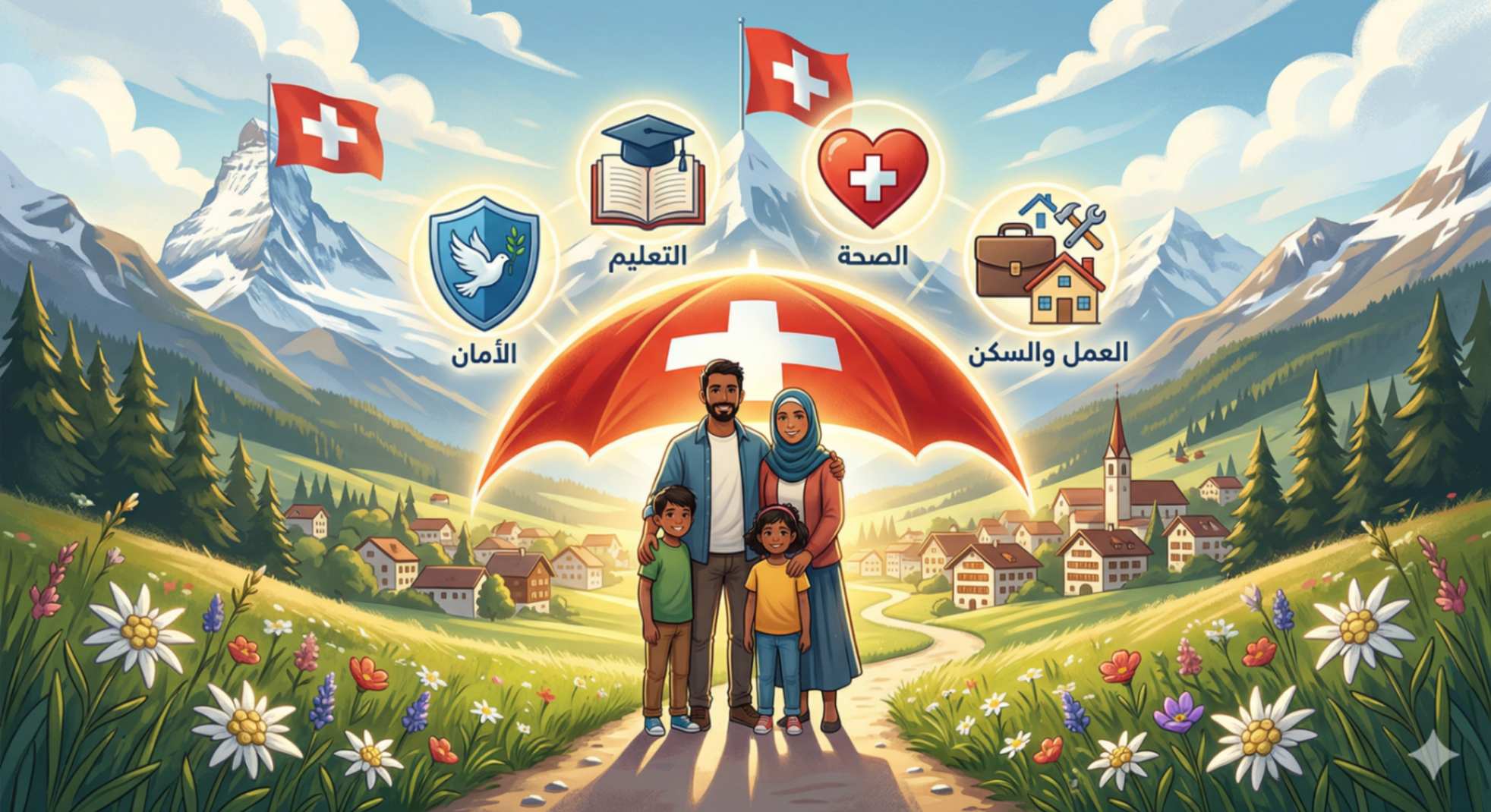
Refugee Rights in Switzerland 2026 – Complete Guide from Residency to Family Reunification
Introduction: Between Strict Laws and Actual Protection
Switzerland is a highly organized country, and this is reflected in everything, including refugee rights. The system here is clear and precise: if you are granted protection, you have specific and guaranteed rights; if you are still in the waiting phase, your rights are limited. It is crucial to know the difference between the procedural stages and the types of protection, so you don't expect things you might not receive, exactly as we explained previously in our comprehensive guide on Asylum in Switzerland.
In this article, we will review every stage step-by-step, from the moment you submit your application to obtaining permanent residency, detailing exactly what your rights and obligations are.
First: The Difference Between Permit B and Permit F (Crucial)
In Switzerland, there are two primary types of protection for those who receive a positive decision:
Permit B – Refugee Status (Flüchtlingseigenschaft)
This is full acceptance and official recognition. You receive this if you prove that you are persecuted in your home country due to religion, race, political opinion, or membership in a particular social group.
- Duration of Residency: Granted for an initial year, after which it is renewed and becomes valid for 5 years.
- What are your rights? The right to work immediately, the right to family reunification, and obtaining a refugee travel document.
- When can you get permanent residency? You have the right to apply for it after 5 years of holding a B permit.
Permit F – Temporary Admission (Vorläufige Aufnahme)
This permit is granted to those who do not fulfill the requirements for full refugee status, but at the same time cannot be deported because their home country is experiencing war, or they are threatened with torture or general danger.
- Duration of Residency: Granted for one year, reviewed and renewed annually.
- What are your rights? The right to work (but often after a waiting period and more complex procedures); however, family reunification is extremely difficult.
- The Major Difference: You are not considered an official refugee under the Geneva Convention, and the travel document issued to you is different and restrictive.
Tip: If you receive a Permit F, try to request a change to Permit B if your circumstances change or if you obtain new evidence proving personal persecution, because the difference in rights between the two is significant.
Second: Rights During the Waiting Period (Before a Decision)
While your file is being examined by the State Secretariat for Migration (SEM), specifically after completing the steps of How to Apply for Asylum in Switzerland, your rights are limited but guaranteed:
1. Free Housing
- In the initial period, you will be housed in a Federal Asylum Centre (Bundesasylzentrum).
- Afterwards, you are allocated to a canton and will live in either collective accommodation (Gemeinschaftsunterkunft) or a shared small apartment.
- Housing is free, but the authorities deduct its cost from your monthly social allowance.
2. Financial Allowance (Sozialhilfe für Asylsuchende)
Approximate figures for 2026:
| Category | Monthly Allowance (CHF) |
|---|---|
| Adult in a reception centre | 350 – 450 |
| Adult in external housing (canton) | 400 – 600 |
| A couple | 600 – 800 |
| Per child | 150 – 250 |
Important Note: Switzerland is one of the most expensive countries in the world. These allowances are designed to cover only basic necessities (food, drink, daily personal needs), and you should not expect to live luxuriously on them. To compare these figures with living costs and actual income, you can read our article on Salaries in Switzerland.
3. Healthcare
- Basic health insurance is entirely free for asylum seekers.
- Covers: Acute illnesses, emergencies, pregnancy care, and basic chronic diseases.
- Does not cover: Cosmetic dentistry, medically unnecessary physiotherapy, and glasses (coverage varies by canton).
4. Education for Children
- Education is compulsory for children from 4 to 16 years old.
- Public schools are completely free.
- In some cantons, there are special preparatory classes for refugee children to learn the language before integrating them into regular classes.
5. Working While Waiting
- After 3 months: You are allowed to work if the canton approves and there is demand in the labor market for your field.
- ⚠️ Warning: Working off the books (without a permit) is considered a crime and directly impacts your asylum decision negatively. To learn the legal ways to work, review the guide on Work in Switzerland for Arabs.
- Immediate: You do not need to wait.
- You can work in any job without special restrictions.
- However, language remains a barrier. If you do not master German, French, or Italian, you will face difficulties finding a job that matches your ambitions.
- A blue travel document (acting as a passport).
- Allows you to travel to most countries in the world.
- Warning: Traveling to your home country is strictly prohibited. If you do so, the Swiss government will assume you no longer fear persecution and will revoke your refugee status immediately.
- You have the right to bring your spouse and minor children (under 18 years old).
- Conditions:
- Proof of marriage with official documents.
- Proof of children's identity.
- Availability of suitable housing that accommodates the family.
- Proof of sufficient income (in some cantons, not all).
- Duration: Processing a family reunification application usually takes between 6 to 12 months.
- After spending 5 years under Permit B, you can apply for permanent residency (Permis C).
- This residency grants you the right to stay in Switzerland indefinitely and without time restrictions.
- You can apply after 10 years of residency in Switzerland (calculated from the date you submitted your asylum application).
- Strict conditions:
- Proficiency in the official language of the canton (at least B1 level).
- Passing a Swiss knowledge test (history, laws, geography, and culture).
- A clean criminal record and full integration into society.
- Not immediate: You may have to wait longer (from 6 to 12 months).
- Laws vary; some cantons facilitate it, while others impose restrictions.
- A grey travel document is issued, which is less globally accepted than the blue one.
- Travel possibilities are very limited and require visas for most countries.
- Extremely difficult: Allowed only in compelling, exceptional humanitarian cases (such as a very young child or a severely ill spouse).
- ⚠️ Warning: This is the most substantial and painful difference between Permit F and Permit B.
- Requires a much longer period (usually 10 continuous years with a Permit F).
- You must prove full economic and social integration (good language skills, financial independence through work, and a clean record).
- You can request to adjust your status from F to B in the following cases:
- Deterioration or change in conditions in your home country making you a target.
- Obtaining new evidence that was not previously available proving you face individual persecution.
- Proving the impossibility of returning to your country for objective reasons.
- Most cantons offer free language courses (German, French, or Italian) for refugees.
- Initially, the focus is on the basics (A1-A2 levels).
- As you progress, you can take advanced courses (B1-B2) at subsidized rates to facilitate your chances of Study in Switzerland.
- If you have no money, you have the right to request a free lawyer.
- The lawyer will help you with:
- Accompanying you during the asylum application and interviews.
- Preparing an appeal if your application is rejected.
- Filing family reunification requests.
- Intensive integration programs are available in almost every canton.
- They include: language courses, workshops introducing Swiss culture and laws, and practical assistance in drafting CVs fo
- Authorities recognize that many refugees suffer from psychological trauma due to war and the journey.
- Free psychological support and therapy programs are available in most cantons (supervised by organizations like the Swiss Red Cross or Caritas).
- Obtaining a Swiss passport is a marathon journey requiring 10 years of residency and strict, costly integration conditions.
- If you receive temporary protection (F), you must be realistic; bringing your family in a short time is extremely difficult.
- Allowances are not enough for a luxurious life in the most expensive European country.
- Sadly, this pushes some to look for illegal work (off the books), which exposes them to severe consequences and threatens their residency.
- Traveling to your country means immediately forfeiting your right to protection without discussion.
- Keep physical and digital copies of every document or letter you submit or receive.
- Take photos of them with your phone and upload them to your email as a secure backup.
- If you change your residence and do not inform the State Secretariat for Migration (SEM), your decisions and appointments will be sent to the old address, and a rejection decision in absentia may be issued against you for missing appointments without your knowledge.
- Leaving the country while your application is being processed may lead to your file being closed and considered as an abandonment of asylum.
- Do not wait for a decision. Learn the language as soon as you arrive; it is an investment that will help you in integration, finding work, and facilitating family reunification procedures.
- OSAR (Swiss Refugee Council): Supports refugees all across Switzerland.
- Caritas: Has branches and consultation offices in most cantons.
- Swiss Red Cross: Provides support in healthcare and emergencies.
- State Secretariat for Migration (SEM): www.sem.admin.ch
- Swiss Refugee Council (OSAR): www.fluechtlingshilfe.ch
- Caritas Switzerland: www.caritas.ch
- Swiss Red Cross (SRK): www.redcross.ch
- For free legal aid: Visit OSAR offices or inquire at your canton's Federal Reception Centre.
Third: Rights After Obtaining Permit B (Refugee Status)
This is where your journey toward a normal, stable life begins:
1. The Right to Work
2. Refugee Travel Document (Reisedokument für Flüchtlinge)
3. Family Reunification (Familiennachzug)
4. Permanent Residency (C Permit)
5. Swiss Citizenship
Fourth: Rights After Obtaining Permit F (Temporary Admission)
Rights here are significantly restricted:
1. The Right to Work
2. Travel Document
3. Family Reunification
4. Permanent Residency
5. Changing to Permit B
Fifth: Additional Rights for All Refugees (Regardless of Status)
1. Free Language Courses
2. Free Legal Aid (Unentgeltliche Rechtspflege)
3. Social Integration
4. Psychological Support
Sixth: Rights That Do Not Exist in Switzerland (Things Not to Expect)
1. You Do Not Get Citizenship Quickly
2. Family Reunification for Permit F Holders is Almost Impossible
3. Low Financial Allowances
4. Traveling to Your Home Country is Strictly Forbidden
Seventh: Recent Figures and Statistics (2025-2026)
| Information | Figure |
|---|---|
| Total number of new asylum seekers | Approx. 25,000 |
| Acceptance rate (Refugee Status B) | 35% - 40% |
| Acceptance rate (Temporary Admission F) | 15% - 20% |
| Overall rejection rate (Ablehnung) | 40% - 45% |
| Top nationalities granted acceptance | Eritrean, Syrian, Afghan, Turkish |
| Average processing time (Fast track) | 2 - 4 months |
| Average processing time (Extended/Regular track) | 6 - 12 months |
Eighth: Practical Tips to Ensure and Protect Your Rights
1. Document Everything
2. Change Your Address Immediately if You Move
3. Do Not Travel Outside Switzerland While Waiting for a Decision
4. Learn the Language from Day One
5. Consult Relief Organizations
Ninth: Conclusion
Refugee rights in Switzerland are clear and strictly codified, but they might seem less generous than their counterparts in other countries like Asylum in Germany or Asylum in the UK. The difference between Permit B and Permit F is massive and dictates your life's path, and the advice of any legal expert is to strive to prove your eligibility for Permit B whenever you possess the evidence. Procedures here are relatively fast, but gaining acceptance requires absolute credibility.
Summary: Switzerland is a country governed by the rule of law. If you follow the rules, are honest, and rely on sound legal advice, your rights are fully protected. Conversely, do not expect excessive allowances or quick, easy family reunification. The cost of living here is high, so planning and swift integration into the labor market is the key to success.
Tenth: Official Sources and Links
حسين عبد الله
حسين عبد الله كاتب محتوى ومطور مواقع وتطبيقات، لديه خبرة في إعداد وتحرير المحتوى الرقمي منذ عام 2016، مع اهتمام خاص بالسفر والهجرة والدراسة والعمل والحياة في أوروبا. يعتمد في كتابة مقالاته على البحث في المصادر الرسمية والمعلومات الموثوقة، ويعمل على تحويل المعلومات المعقدة إلى أدلة واضحة وعملية تساعد القراء والمغتربين والطلاب على فهم الإجراءات والفرص في الدول الأوروبية. يجمع حسين بين الخبرة التقنية والعمل التحريري، ويهتم بتقديم محتوى دقيق ومحدث وسهل التطبيق.