Asylum Rejection Reasons in Switzerland: 20 Common Causes and How to Avoid Them (2026 Guide)
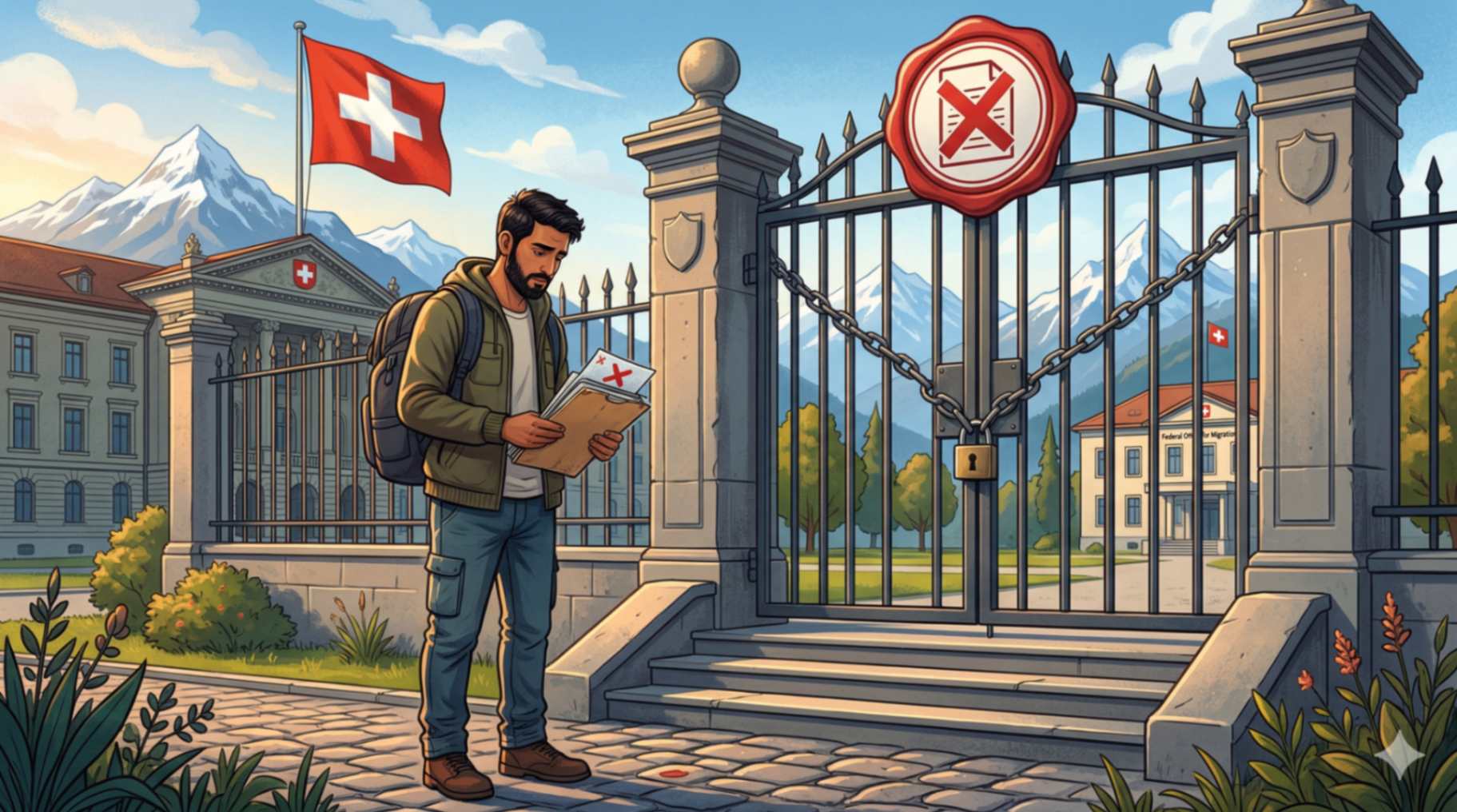
Asylum Rejection Reasons in Switzerland: 20 Common Causes and How to Avoid Them (2026 Guide)
1. Introduction: Why are Asylum Applications Rejected in Switzerland?
Switzerland is a meticulously organized country, and its asylum system is considered among the strictest and most thoroughly scrutinized on the European continent. Thousands of applications are rejected every year by the State Secretariat for Migration (SEM), and the unfortunate reality is that a significant percentage of these rejections occur due to purely procedural reasons or naive mistakes that could have easily been avoided if the applicant understood how the system works.
Reaching Swiss territory is just the beginning. To understand the general framework of your rights, you can review our foundational guide on Asylum in Switzerland: Complete Conditions and Steps. In this awareness guide, we will candidly reveal the 20 most common reasons that cause the dream of protection to evaporate and asylum applications to be rejected in Switzerland. We will also provide practical strategies to avoid each mistake. Most of these pitfalls can be sidestepped with solid preparation, absolute honesty, and the assistance of a professional legal representative from day one.
2. Reasons Related to Credibility and Honesty (Glaubhaftigkeit)
Credibility is the cornerstone of Swiss asylum law (Article 7). If your credibility falls, your case falls.
2.1 Lying or Exaggerating Details (Lügen oder Übertreibung)
SEM officers are highly trained in advanced psychological interrogation techniques to detect deception. If they catch a single lie (even if you considered it a "white lie" to embellish your story), they legally have the right to doubt your entire narrative.
- Real-world example: An asylum seeker claimed their house was raided by security forces on a specific date, but upon examining their mobile phone records (which are usually confiscated and extracted), it was revealed they were in another city or out of the country on that day.
- ⚠️ Warning: Never lie. Even a small lie to cover up a minor detail can destroy your entire credibility. Absolute honesty is your only survival option in Switzerland.
2.2 Contradictions in Your Story (Widersprüche)
When pivotal details of your story differ between the initial registration interview (Erstbefragung) and the comprehensive substantive interview (Anhörung), the SEM considers this a fatal contradiction that undermines your application.
- Example: Stating in the first interview that you fled your country in the summer of 2023, and then in the substantive interview (which might happen months later) stating you left in the winter of 2022.
- How to avoid it?
- Review your story and its exact chronological timeline with your lawyer before any session.
- Memorize crucial dates (arrests, threats, departure).
- If you forget a date, state clearly "Ich erinnere mich nicht genau" (I don't remember exactly); this is a thousand times better than guessing a date that traps you in a contradiction.
2.3 A Vague or Undetailed Story (Vage Geschichte)
If your narrative is superficial, generic, and lacks vivid details (such as names, exact dates, descriptions of places, and facial features of individuals), the Swiss investigator will consider it a "rehearsed" or unconvincing story.
- Example: Saying "They persecuted me and threatened to kill me" without explaining exactly who they are, how they threatened you, by what means, when and where it happened, and why you specifically were targeted.
- How to avoid it?
- Write down your story in excruciating detail with your lawyer before the hearing.
- Add details that only someone who lived the event would know: the colors of the detention cell walls, surrounding street names, officers' ranks, weather details on the day you escaped.
2.4 Delay in Submitting the Asylum Application (Verspätetes Asylgesuch)
If you manage to reach Switzerland and then live there (or in Europe) illegally for months or years before deciding to apply for asylum, the judge and the SEM will wonder: "If you truly feared for your life from an imminent threat, why did you wait all this time to seek protection?"
- ⚠️ Warning: Submit your application the moment you step onto Swiss soil. To know the correct and fast mechanism, check How to Apply for Asylum in Switzerland Step by Step. Any delay requires a highly convincing medical or psychological justification.
2.5 Not Mentioning the Core Reason at the First Opportunity
If you arrive at Geneva or Zurich airport and tell the border control officer you are here as a "tourist" to facilitate entry, and then claim asylum weeks later, this will be recorded against you as evidence of manipulation. The intention to seek asylum must be declared immediately upon contact with authorities.
3. Reasons Related to Documents and Evidence
3.1 Lack of Identity Documents (Fehlende Identitätspapiere)
Swiss law emphasizes the necessity of proving identity. If you do not provide any document (passport, national ID card, driver's license), it becomes difficult for authorities to verify your nationality, heavily complicating your file.
- How to avoid it?
- Keep any official document you possess, even if it is expired.
- If you truly lost them, explain the reason with complete honesty (stolen in the forest, confiscated by a smuggler, or destroyed out of fear of detection at checkpoints).
3.2 Forged Documents (Gefälschte Dokumente)
The Swiss Federal Police possess some of the world's most advanced document examination labs. If you present a forged ID or fake court summons, it will inevitably be discovered.
- ⚠️ Severe Warning: Never submit forged documents, and do not listen to smugglers' advice. Presenting forgeries is considered fraud, which may lead to your file being closed, imprisonment, and subsequent deportation.
3.3 Lack of Supporting Evidence (Fehlende Beweismittel)
An oral narrative might be accepted if it is highly coherent, but physical evidence tilts the scales in your favor. A lack of evidence combined with a weak story leads to rejection.
- How to avoid it?
- Gather any paper that proves your story: medical reports documenting torture marks, arrest warrants, local newspaper clippings mentioning your name, printed or phone threat messages.
- Ask your lawyer or relatives back home to scan the documents and send them to you securely.
3.4 Contradiction Between Your Story and the Evidence
If you state in the interview that you suffered a gunshot wound in January 2021, but the medical report you submitted as evidence is dated March 2022 and mentions no gunshot injury, this contradiction will be used to entirely discredit your story.
4. Reasons Related to the Substantive Interview (Anhörung)
4.1 Poor Interview Performance (Schlechte Leistung im Interview)
The interview lasts for long, exhausting hours. If you appear overly nervous, confused, stuttering, or unable to recount events in a logical sequence, the officer might interpret this as fabricating a fake story, rather than attributing it to fear or trauma.
- How to avoid it?
- Conduct a "mock" interview with your legal representative before the actual date.
- Take your time before answering. Drink water, breathe deeply.
- If you don't understand a question due to phrasing, you have the right to ask for it to be rephrased.
4.2 Not Requesting a Different Interpreter When Needed (Probleme mit dem Dolmetscher)
The interview is conducted in your native language, but what if the interpreter speaks an Arabic dialect you don't understand well (e.g., you are Iraqi and the interpreter is Moroccan)? If you stay silent and answer based on guessing the question, a disaster will be recorded in the official transcript (Protokoll).
- Tip: If you struggle to understand the interpreter or feel they are summarizing your words, stop the interview immediately and request a different interpreter. This is your absolute legal right and will not negatively impact your case.
4.3 Anger or Emotional Outbursts (Wut oder emotionale Ausbrüche)
Officers might deliberately ask provocative or skeptical questions to gauge your reaction. Negative outbursts, anger, or shouting will be logged in the report as "uncooperative" or "hostile" behavior.
5. Reasons Related to Countries of Origin and Internal Displacement
5.1 Arriving from a "Safe Country" (Sicherer Herkunftsstaat)
The Swiss Federal Council classifies certain countries as safe, assuming no systematic state persecution occurs there. The burden of proof falls entirely on you to demonstrate that you are an exceptional case.
- List of Safe Countries (2026): Albania, Bosnia, Kosovo, North Macedonia, Serbia, Ghana, India, Senegal, Georgia, Tunisia, Algeria, and Morocco.
- ⚠️ Warning: If you are from these countries, you are placed in a Fast-Track procedure, and your rejection rate exceeds 95% unless you provide indisputable evidence of personal targeting by influential actors that the state cannot protect you from.
5.2 Existence of a Safe Zone Within Your Country (Innerstaatliche Fluchtalternative)
If you are fleeing tribal conflict or local persecution in a specific city in your country, the SEM will ask: "Your country is large; why didn't you move to the capital or another province instead of taking the trouble to seek asylum in Europe?" If you don't have an answer proving the danger tracks you every inch of your country, your application will be rejected.
5.3 Changes in the Political and Security Conditions in Your Country
SEM updates its reports continuously. If you fled a dictatorial regime, but during the processing of your application that regime falls and conditions improve, a rejection decision will be issued based on the cessation of the reasons for fearing persecution.
6. Reasons Related to the Dublin System (Dublin-Verordnung)
6.1 Having Fingerprints or a Visa in Another European Country
Switzerland applies the Dublin Regulation rigorously. If you were fingerprinted in Greece, Italy, or Croatia, or hold a "Schengen" visa issued by a French embassy, Switzerland will consider that country responsible for processing your application and will not examine the substance of your story (Nichteintreten). To understand how Switzerland's major neighbor applies this system, check out How to Apply for Asylum in Germany.
- ⚠️ Severe Warning: The Dublin fingerprint is the number one reason for procedural rejection in Switzerland. Hiding to outlast the 6-month (or 18-month) period has become extremely difficult with strict police measures.
6.2 Holding Residency or Protection in Another Country
If you have permanent residency in a Gulf state or asylum residency in another European country, you are not entitled to claim asylum in Switzerland and will be immediately deported to the country granting you residency.
7. Reasons Related to Personal and Legal Conduct
7.1 Having a Criminal Record (Strafregister)
Switzerland places the security of its society above all considerations. Committing any crimes (such as theft, assault, or drug trafficking) either in your home country or during your temporary stay in Switzerland will lead to your exclusion from asylum (Asylausschluss).
7.2 Prior Immigration Law Violations (Verstösse gegen das Ausländerrecht)
If you previously entered Switzerland on a tourist visa and overstayed, or were previously deported and returned under a different identity, this black record destroys any credibility of your current application. Remember that clandestine or black-market work is strictly forbidden; to understand legal pathways, review Work in Switzerland for Arabs.
7.3 Suspicions of Extremism and Terrorism (Terrorismus oder Extremismus)
The Swiss Federal Intelligence Service (FIS) conducts security background checks. Any positive interaction with extremist posts on social media, or links to banned groups, means a categorical and long-term rejection.
7.4 Involvement in War Crimes (Kriegsverbrechen)
If you were a former soldier or fighter in an armed faction and were involved in war crimes or grave human rights violations, you are excluded from Geneva Convention protection under Article 1F.
8. Reasons Related to Legal Representation and Counseling
8.1 Not Relying on a Legal Representative (Kein Rechtsvertreter)
Even though Switzerland provides a free legal representative in federal reception centers, some asylum seekers ignore their advice or hide true information out of fear or ignorance. The lack of coordination with your lawyer makes you easy prey for the SEM's complexities.
8.2 Incompetent or Disinterested Lawyer (Unfähiger Anwalt)
If you are transferred to a canton and forced to find a private lawyer for an appeal, choosing a lawyer who does not specialize in immigration, or does not give your file adequate time, will result in poorly written briefs ending in a rejected appeal.
9. Golden Tips to Avoid Rejection and Secure Your Protection in Switzerland
- 1. Register Immediately: The moment you enter Swiss territory, head to the nearest police station or BAZ center.
- 2. Trust the Free Lawyer: The legal representative (Unentgeltliche Rechtspflege) works for you and is independent of the government. Tell them everything honestly.
- 3. Absolute Honesty: Honesty s
10. What to Do if Your Application is Rejected? (The Second Chance)
Do not lose hope immediately upon receiving a negative decision (Negativer Entscheid). The Swiss legal system grants you the right to appeal:
- Read the Legal Deadline Carefully: In a regular procedure, you have 30 days to appeal. In Dublin or fast-track procedures, the deadline may shrink to just 7 days!
- Consult a Lawyer Immediately: Go to the consultation center of the Swiss Refugee Council (OSAR) or the lawyer assigned to your file to file an appeal (Beschwerde).
- Federal Administrative Court (BVGer): This is the supreme authority in St. Gallen that will review the appeal. The court is independent and may overturn the SEM's decision if your lawyer proves evaluation errors or presents new evidence.
- Gather New Evidence: The appeal period is your last chance to submit any recent medical reports or proofs you failed to present during the interview.
11. Checklist to Avoid Rejection
Before you walk into your asylum interview, make sure you check these boxes:
- I sat with my legal representative and explained my full story without hiding anything.
- My story is chronologically organized and memorized accurately.
- I have submitted all identity and nationality documents (or have a strong justification for losing them).
- I handed over all the evidence I possess and informed the lawyer of other evidence I will bring later.
- I am mentally prepared and will request an interpreter who understands my exact dialect.
- I abide by the housing laws and have not committed any offenses in Switzerland.
12. Conclusion: Knowledge is Power... Use It to Protect Your Future
Receiving an asylum rejection letter in Switzerland is not the end of the world, but it places you in a highly difficult psychological and legal position; thus, prevention and avoiding mistakes from the start is the smartest solution. The Swiss system is very strict with no room for fabricated stories, but at the same time, it is a fair institutional system that protects everyone who proves a genuine need for protection according to evidence and law. To learn how other countries handle rejection decisions and compare systems, you can read our article on Asylum Rejection Reasons in the UK.
You are not alone on this journey. Swiss relief organizations and volunteer lawyers are dedicated to ensuring you receive a fair hearing. Arm yourself with honesty and organization, as they are the keys to your survival.
Call to Action: Did you face complications during your SEM interview, or were you asked surprising questions? Share your experience (without mentioning personal details or names) in the comments below, so it can serve as a lesson for others walking the same path.
13. Frequently Asked Questions (FAQ)
- What is the most common reason leading to a quick asylum rejection in Switzerland? Having a prior fingerprint in another European country (Dublin system). Examining the details of your case is denied, and a decision is issued to deport you to the fingerprinting country.
- Can my application be rejected because I delayed applying? Yes, waiting a long time after arriving in Europe or Switzerland before seeking asylum is considered evidence of a lack of a "well-founded" and urgent fear of persecution.
- What if my documents and passport are lost? The absence of documents complicates the file but does not mean automatic rejection if your story is highly convincing and explains why the papers were lost (e.g., sinking at sea).
- Does working without a permit affect my asylum application in Switzerland? Absolutely. Black-market work (Schwarzarbeit) is a serious violation of Swiss laws and can destroy your chances of obtaining residency and threaten you with deportation.
- What is the appeal deadline after receiving a rejection decision? It ranges from 7 working days in fast-track and Dublin cases, to 30 days in regular procedures.
- Can I submit a new application (Folgegesuch) after a final rejection? Yes, but only if substantial and completely new evidence emerges that did not exist during your first application, or if the security situation in your country drastically worsens.
- What does "Safe Country" mean, and how does it affect my application? These are countries Switzerland classifies as not practicing systematic persecution (like North African and Balkan countries). Applicants from these countries usually receive a quick rejection unless they have conclusive individual evidence.
- What is the Federal Administrative Court (BVGer)? It is the supreme court competent to hear appeals against decisions made by the State Secretariat for Migration (SEM), headquartered in St. Gallen, and its decisions are final.
14. Official Sources and Links (Start Your Search Here)
- Official portal of the State Secretariat for Migration (SEM) for visa details: www.sem.admin.ch
- Swiss Refugee Council for consultations (OSAR): www.fluechtlingshilfe.ch
- Federal Administrative Court (BVGer) to track appeals: www.bvger.ch
- Caritas Switzerland for legal and social support: www.caritas.ch
- Swiss Red Cross (SRK) for care and health: www.redcross.ch
حسين عبد الله
حسين عبد الله كاتب محتوى ومطور مواقع وتطبيقات، لديه خبرة في إعداد وتحرير المحتوى الرقمي منذ عام 2016، مع اهتمام خاص بالسفر والهجرة والدراسة والعمل والحياة في أوروبا. يعتمد في كتابة مقالاته على البحث في المصادر الرسمية والمعلومات الموثوقة، ويعمل على تحويل المعلومات المعقدة إلى أدلة واضحة وعملية تساعد القراء والمغتربين والطلاب على فهم الإجراءات والفرص في الدول الأوروبية. يجمع حسين بين الخبرة التقنية والعمل التحريري، ويهتم بتقديم محتوى دقيق ومحدث وسهل التطبيق.